Showing posts with label Ireland. Show all posts

Monday, February 27, 2012

The Whipping Club by Deborah Henry

A heart-wrenching novel about painful abuses in Irish Catholic Institutions

Synopsis:

Deborah Henry's new historical novel, THE WHIPPING CLUB (T.S Poetry Press, March 2012) is a literary page-turner and a tale of redemption, set against the backdrop of violence and deeply entrenched prejudice in 1960s Ireland as told through the heartrending experience of one inter-faith family. In it, an Irish Catholic woman, Marian, in love with a Jewish journalist hides the birth of her out-of-wedlock child to save her future marriage. The child she has relinquished does not end up with an American family as promised. Instead, he is committed to a notorious Catholic orphanage where there is little hope for his survival.

Tormented by feelings of remorse and guilt that have plagued her throughout her marriage to the boy's father, the woman must confront the truth and reveal her long-buried secret. While putting her marriage and family at risk, she determines to save her son and in so doing correct the terrible wrongs of her own past and challenge a system that chronically serves up children to abusive clergy.

Using a hidden Ireland as a backdrop, an island in which thousands of adults and children were forcibly separated in the 1950's and 1960's, the novel explores the sacrificial secrets we keep to protect our loved ones and their impact on a marriage, a family and a society. THE WHIPPING CLUB raises powerful questions about the nature of sin, guilt, and redemption by chronicling a young boy's perilous travels through a corrupt system and one couple's heartbreaking struggle to bring him home.

The Whipping Club is a timely novel that makes a powerful statement, revealing the sufferings of victims and families at the hands of the Catholic Church in the mid 1900’s. Although the story focuses on Ireland’s orphanages, Magdalene Laundries, and homes for unwed mothers, parallels can be drawn in many other countries where survivors of similar institutions are coming forward.

The story centers around one family. Marian is a Catholic teacher at a Zionist school who falls in love with a young Jewish man named Ben. When she discovers she is pregnant, she tries to tell Ben, but his mother’s antagonism at her religious background forces her to keep her secret. Instead, she enters into a special hospital/home for unwed mothers where she puts her son up for adoption, assured he will find a good family in America.

Marian and Ben marry and they have a young daughter. All seems perfect until one day, she learns the son she gave up for adoption is still in the Catholic orphanage she originally left him in. Ben and Marian take legal action to acquire custody of their son, Adrian, and begin to assimilate him into their lives. But he is under the custody of the nuns at the orphanage and they, together with the court system, maintain their hold and custody of the boy.

Not for the faint of heart, this novel addresses several complicated and painful issues that are coming forward in today’s society. For the sake of the survivors, it is important to learn about what truly happened, to understand, and to learn from these mistakes so that such things never occur again. As a Catholic myself, it was a shattering experience to read about the harsh punishments, cruelties, and sexual abuse against innocent children and the prejudices against unwed mothers. I admired the fact the author took care to not only portray depraved or cruel religious members, but also those who were loving and kind, albeit the former outweighed the latter in numbers.

What I admire is that the author had the courage to deal with such contentious issues such as deeply ingrained religious beliefs, transgressions, mercy, and the devastating consequences of not speaking out. This novel has depth and punch. It is not a light read – one should not skim over the words light-heartedly. Rather, readers need to prepare themselves to face a realm of emotions as they read and try to understand the true purpose for which the author wrote such a story. This heart-wrenching tragic drama has depth and richness. Despite the painful topic, the author leaves the reader with hope at the end. Bravo Deborah Henry for having the courage to address such tragic and painful realities in our recent past.


Saturday, November 12, 2011

Once A Goddess by Sheila R. Lamb

An exciting debut novel about Ancient Ireland


Two tribes battle for control of ancient Ireland, and Brigid must find her place among them, trapped between the will of her people and the desires of her heart.

For the sake of peace, Brigid of the supernatural Túatha dé Danann enters into an arranged marriage with Bres, the next chieftain of the enemy Fomorian tribe, whose iron weapons and brute strength challenge the Danann magic. The Danann instruct Brigid to spy for them, and to keep the source of their powers secret, dangerous tasks that complicate her goal of making the best of her forced union.

Sacrificing her own hope for love, Brigid faces the Fomorians alone. She must confront her rival, Morrigan, who competes for Bres's affections, as she begins to suspect that he is breaking the truce through lies and political manipulation. When his tyranny threatens the very existence of the Danann, Brigid must risk her life to unseat Bres from power.

Set in a time when myths were reality, Once A Goddess brings the legend of Ireland's magical Túatha dé Danann to life.

I enjoy historical fiction because a story can sweep me into foreign lands and eras in the past I know little about. Once A Goddess, by Sheila R. Lamb introduces to three sets people named the Túatha dé Danann, the Fomorians, and the Fir Bolgs in ancient, mythological Ireland.

From the moment I began reading, the rich prose set a vivid picture and endeared me to Brigid, a young woman obligated to marry Bres, the future chief of an enemy tribe, in order to keep peace between them. But she is expected to spy and report findings to her village leaders. As she adjusts to the foreign ways of her new village, Bres is a good husband. But soon, dark secrets arise to threaten their peace. Thrust into a near impossible situations, Brigid must make some hard choices, and it is this, in addition to the tantalizing way in which the author reveals the secrets, that drives the story.

Unrequited love, passionate liaisons, lies and deception, treachery and betrayal line this novels pages. It is an emotionally provocative and compelling story and I enjoyed the exotic setting and adventure this story offers. A unique book worth reading and highly recommended.

Tuesday, July 12, 2011

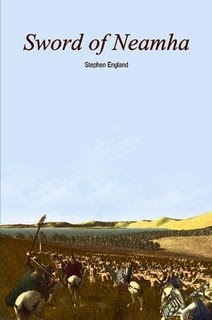
Sword of Neamha by Stephen England


In Stephen England’s the Sword of Neamha, Cadwalador of the Aeudi tribe sets out from northern Gaul with his beleaguered people, fleeing from certain annihilation by other tribes. Life takes him on an unexpected adventure. He makes fateful choices that determine his destiny and ensure the fate of his people.


Cadwalador is a young man in the service of a Gallic chieftain, who is heir to the leader of the Aeudi. The tribe is under siege and flees their shores, intent on conquering the land of Erain (Ireland), with stops along the way on the island of tin (the future Britain). Cadwalador’s chieftain inspires others to flow his banner, with two fatal weaknesses: his love of strong drink and his ruthless ambitions. He is a dangerous man, made even more so when he is drunk. He earns the enmity of one of the mercenaries in his service, Cavarillos, after an ill-advised attack on a village sees scores of Aeudi die needlessly. Cadwalador counted Cavarillos among his friends, but the two have a bitter parting when the young man chooses his chieftain’s life over helping his friend. It is a decision that will shape Cadwalador’s life. He pays a heavy price for his loyalty and, in the end, loses more than he expected. He also helps forge a powerful legend across the land, but with ruthless enemies closing in on all sides, it’s not always certain that legend will be enough to win the day.  

Several elements stood out in this story. Despite the foreign and often un-pronounceable Celtic names, there were familiar themes. There is the flush of first victory and first love, as well as bitter treachery and defeat, enough to entertain historical fans who like gritty action. The scenes are visceral. There’s blood and guts everywhere. The action never stops, even in what should be quiet family moments for Cadwalador. Of all the things I admired about Mr. England’s style, it was the way in which he creates sympathy for his characters, especially those who at the outset don’t seem to deserve it. Even his villains have justifiable reasons for their murderous nature. The Sword of Neamha is a fascinating read for anyone who like historical fiction set in the Celtic or early Britannic period, or those who enjoy epic battle scenes and action that propels the characters through upheaval and triumph.        
Available at Smashwords, B&N and Lulu. Also,  


Saturday, April 16, 2011

The Circle Cast - The Lost Years of Morgan Le Fay


Reviewed by Laurie Rezanoff

I am a huge fan of all things King Arthur, Camelot and magic. I remember clutching my special sticker book full of the images of the Knights from the Round Table, Guinevere, Sir Lancelot et al wherever I walked at the age of 5.

In only a few instances have books (Marion Zimmerman), TV (Merlin) or movies (such as "Excalibur") dealt with Morgana or Morgan Le Fay, the half-sister to Arthur. How she became a sorceress, and where she lived before entering Arthur's life have either been overlooked or barely explained. Until now. I thoroughly enjoyed Alex Epstein's look into her life, in Ireland and how that exile helped her to become the driven and powerful woman she was later known to be.

I look at this book as the prequel to the King Arthur myth and legend. Alex has done a superb job of enlightening the reader to the real history of the times, without losing the storytelling aspect. I felt totally drawn in and transported to 480 A.D. Ireland, to the land itself, while learning the true spelling/pronunciations of the name places prior to eventual Saxon changes.

I truly believe there is natural energy within Mother Earth and the four elements that Druids and other such sensitive people were able to connect with, harness and hopefully use for the good of all. I also believe there were (and still are) people in the world who used such energies for their own corrupt power and control over life circumstances beyond their control. Morgan Le Fay became one of these people, and she continued to choose revenge no matter how good her life became in Ireland.

Born in the US and now living in Montreal, Quebec, Alex has captured the raw energy of the land, the people of that time in history, and the mythical person who we know as Morgan Le Fay. Her encounters with power-hungry figures influenced her decisions and ensured her survival to become the Sorceress of legend. Her thirst for revenge against the man who killed her father and changed her life forever was never quenched, yet it certainly was later transferred onto Arthur.

Enjoy this adventurous journey into the Unknown, part of the Quest that would later be, the legend of Camelot, magic, Morgan Le Fay and King Arthur.


Tuesday, January 25, 2011

The Matchmaker of Kenmare by Frank Delaney

Reviewed by Mirella Patzer

Ben McCarthy is a young man haunted by the mysterious disappearance of his beloved wife, Venetia. Although many suspect she is dead, possibly murdered, Ben searches for answers as to what happened and why. His work as a researcher/writer for the Irish government’s folklore department not only keeps him travelling throughout the country in search of myths and legends, but it provides him with the cover to make his own inquiries about Venetia’s disappearance. His travels soon take him to the town of Kenmare to interview a matchmaker named Kate Begley who has recently married Captain Charles Miller, an American, on a secret mission behind enemy lines in war-torn Europe. Known as Killer Miller, before her husband departs on his dangerous mission, he extracts Kate’s promise that she would search for him behind enemy lines should he ever turn up missing or become listed as dead.

Meanwhile, an abiding friendship develops between Ben and Kate. When the military notifies Kate of her husband’s death, her intuition warns her that her husband is still alive and she convinces Ben to accompany her on a quest that not only spans years, but takes them into the heart of German camps in Europe and across the ocean to America.

The Matchmaker of Kenmare is told in the first person narrative of Ben as he relays the story of his past to his daughters. The voice of Ben is presented with clarity and definition, immediately capturing the reader’s interest. The parallel between Ben and Kate’s search for their lost loves is a major theme throughout the novel. Their travels sweep readers into lesser known places in Ireland and later into real and eminent danger in other European countries, which provides plenty of tension and a sense of urgency to the story which keeps one engaged to the very end. Although this novel is a sequel to Venetia Kelly's Traveling Show, it is not necessary to read the first book in order to enjoy this fabulous tale of romance and mystery and its unforgettable characters.


Friday, May 21, 2010

The Sea and the Silence by Peter Cunningham

In the middle of the 20th century, Ireland is a country plagued by social/political unrest. Iz, a beautiful young woman, has moved to the town of Monument to carve a new life with her husband Ronnie, and small son, Hector. Ronnie works as an auctioneer of land, and as their marriage progresses, Iz discovers he has made several devastating business deals and has been unfaithful. As Hector comes of age, he leaves Monument and joins the army. Over time, Iz's once happy life and marriage, disintegrates until Iz finds herself alone.

The second half of the book sweeps the reader into Iz's life before she married Ronnie. It is here that we really come to know and understand her. Family pressures to save their familial lands forces Iz to betroth herself to a man she does not love. All the while, her heart belongs to Frank, a man deeply involved in political subterfuge. But meddling family and friends thwart all their attempts to be together.

What makes this novel unique is the unusual way the story unfolds. The author weaves this complex story in reverse order. We learn about Iz's later life first and early life later. Like gently peeling an onion, bit by bit, the story is revealed. Although a bit perplexing at first, I found this style of storytelling helped to build suspense as the story progressed. It wasn't until the second half of the book that this tale truly gains momentum.

It took a while to initially fall into the story because the writer used dashes instead of quotation marks for dialogue and often didn't break the dialogue with new paragraphs when different characters spoke. It made for a rough start and kept me from engaging with the story in its early stages, but once I became accustomed to it, I did settle into the story.

Readers who persevere into the second half of the story will find themselves rewarded with the revelation of many secrets and a deeper understanding of Iz and the turmoil in her life. Along the way, the reader will discover beautiful descriptions of Ireland, an understanding of the country's struggles, along with some lovely prose. The ending leaves the reader haunted because of its poignancy. A unique novel about a beautiful country that has faced many hardships throughout history.

Thursday, April 22, 2010

Excerpt: A Cruel Harvest

As the vessel cleared the harbour, the chained villagers were led through a hatchway into the confines of the main hold. The hold was layered with tiers of decking so that they could be arranged in rows, each deck placed no more than fifteen inches above the lower one. Under this system a surprisingly large number of bodies could be accommodated. The space between each tier was so narrow that a person was unable to turn on either side but was forced to lie flat. Every available portion of room was utilised, and the captives were squashed together, their manacled arms and legs overlapping.

Brannon had only regained consciousness a while earlier; he was tottering shakily on his feet, and now his stomach heaved when he caught a whiff of the stench inside the hold. It was vile, like rotten meat, and he fought to suppress a wave of nausea. Behind him one of the other captives vomited; he heard it splashing near his feet, and immediately the insufferable smell worsened.

It was difficult to see in front, the hatchway providing the only means of light. They were pushed along a narrow aisle by the decking and one by one allotted to a space. The crew worked diligently, securing loops on the chains through rings bolted to the bulkheads. Brannon was desperate to avoid this fate, being shackled down like a dog, but with the manacles restricting his hands and legs there was no chance of him mounting a fight against the brawny Arabs. As if to remind him of this fact, one of them cuffed him hard in the ear and shoved him on to the decking.

He found himself bundled beside two other men and could only squeeze his long frame between the tiers with great difficulty. There was barely enough room to lift his head, much less to move his body. He feared suffocation and took deep breaths to steady himself, though that was difficult in the foul, torpid airs of the hold.

‘Looks like we’re to be bedfellows,’ the man next to him grumbled.

Brannon recognised him as Pat Browne, a retired sailor who rented a farm near Dromkeen. ‘Who are they, Pat? What are they doing with us?’

‘You don’t want to know, young Ryan.’

With their prizes now safely stowed, the crew climbed out and shut the hatch, plunging the hold into darkness. A moment of silence passed. Then somebody began to sob in some corner, and this triggered off a clamour of wailing and lamenting. People wept and cried out to God, or yelled angrily, demanding answers. The cacophony of human anguish made it impossible to converse with anyone, and Brannon closed his eyes, trying to shut them out. He was dazed and confused, still unsure of what was happening or who the fearsome-looking foreigners were. This nightmare, however, was one he couldn’t wake from.

Tuesday, April 20, 2010

A Cruel Harvest by Paul Reid

Paul Reid’s debut novel, A Cruel Harvest, is an irresistible tale that intertwines romance and adventure in one breathtaking sweep. Reid’s book transports the reader to faraway places with striking realism: from the verdant, wind-blown Irish coastline, to the squalor of a slave ship, to the opulence of a sultan’s palace, and to the desolate sun-scorched deserts of Morocco. This book will not only capture your imagination, but your heart, as well.

The story begins with two young lovers, Brannon Ryan and Orlaith Downey, whose lifelong future together is clearly fated. But when Moroccan pirates raid the tranquil little village of Dromkeen, their courtship is cruelly interrupted as Brannon is seized and tossed into the hold of a cramped and filthy ship. For those captives who survive the voyage, the ordeal is far from over. Brannon’s trials begin with backbreaking labor and his plight increases tenfold when he is forced to serve in the sultan’s army. Through it all, we see a fearless and sometimes headstrong Brannon, determined to do whatever is necessary to return to his beloved.

Back in Ireland, even though Orlaith evaded capture, she soon faces her own grueling hardships. Even while trying to raise her son on her own and scratch a living out of a meager patch of land, she still clings to the faith that Brannon has survived. But as Brannon’s absence lengthens and starvation threatens her son’s very life, it seems her only hope is to wed the heartless and ignoble landowner, Randall Whitely. In her own right, Orlaith is both courageous and strong, a heroine to root for. It is impossible not to become emotionally engaged with both Brannon and Orlaith, as each battles their own moral dilemmas.

A Cruel Harvest is an ardent love story filled with majestic vistas, characters both frighteningly and heartwarmingly real and action so intense you’ll feel your pulse quicken. The contrast between the two settings, Ireland and Morocco, and the exquisite detail with which Reid portrays them guarantees that this will be a captivating read from beginning to end. This is one of those rare books you won’t rush through, simply because you’ll want to savor every word. The clarity of the storytelling and poeticism of the prose makes it a truly memorable read.