Showing posts with label 21st Century. Show all posts

Tuesday, February 14, 2012

The Orchid House by Lucina Riley

A beautiful story!
Synopsis:

As a child Julia Forrester spent many idyllic hours in the hothouse of Wharton Park, the great house where her grandfather tended exotic orchids. Years later, while struggling with overwhelming grief over the death of her husband and young child, she returns to the tranquility of the estate. There she reunites with Kit Crawford, heir to the estate and her possible salvation.

When they discover an old diary, Julia seeks out her grandmother to learn the truth behind a love affair that almost destroyed Wharton Park. Their search takes them back to the 1930s when a former heir to Wharton Park married his young society bride on the eve of World War II. When the two lovers are cruelly separated, the impact will be felt on generations to come.

Lucinda Riley skillfully sweeps her readers between the magical world of Wharton Park and Thailand during World War II with irresistible and atmospheric storytelling. Filled with twists and turns, passions and lies, and ultimately redemption, The Orchid House is a romantic, poignant novel that became an instant bestseller in the UK and Germany.

The Orchid House is a tantalizing story involving a grieving heroine, a secret diary, an ancient mansion, and long buried family secrets. The story’s main character is Julia who is grief-stricken over the death of her husband and son. She returns to her roots – a dilapidated mansion where she once spent countless hours with her grandfather in the conservatory watching him tend to orchids. There she meets the heir to estate and a friendship is sparked between them. The discovery of an old diary, long forgotten, sweeps Julia into the past where she uncovers family secrets and which ultimately help her heal.

Told through some flashbacks between the present and the past, these tantalizing reminisces helped build momentum and kept me enthralled to read further. The story held my interest with its twists and turns and fascinating characters. I immediately sympathized with the heroine whose grief and pain, as well as her gradual healing, was well portrayed. I especially enjoyed how the theme of a rare orchid flowed from start to finish. I cannot say enough about how lovely this book is to read. Utterly beautiful! Completely satisfying!

Tuesday, October 18, 2011

Shadows by Jen Black

A contemporary paranormal romance that will keep you turning the page!


Back Cover Blurb:

Melissa thinks she’s taking a huge risk in going on holiday with Rory Hepburn. He may be gorgeous, but she only met him three days ago. But when she sees the old watermill in rural France, she is delighted. Within ten minutes of her arrival, she sees the man in black, but thinks nothing of it.
Concentrating more on keeping her secrets and sleeping alone, she is shocked when ghosts disturb her first night at the mill. Not just one ghost, but two. When Christophe arrives at the mill, the chic Frenchman regards Melissa as his soul mate, and Melissa knows she’s in real trouble.

A chilling tale, written with humour and drenched in the sights and perfumes of the rural Dordogne, this is a must-read tale for those who like a romance with a ghostly twist.


An avid follower of Jen Black’s novels, I could not resist reading Shadows, her newest book and first venture into contemporary paranormal romance.

When Melissa meets the handsome Rory at a party, she is instantly drawn to him, but is hesitant and a bit mistrustful due to past romantic failures she has been painfully trying to put behind her. Rory invites her for a three week holiday in France at an ancient mill. Unexplainably drawn to him, Melissa agrees, and is determined to enjoy herself despite the fact she remains wary and does not easily trust him.

Shadowed by the secrets of their past, and surrounded by the spectacular beauty of the old mill, Rory and Melissa’s holiday soon turns perplexing and secrets begin to emerge. Not only do they encounter ghosts, but secrets of their past begin to emerge. Mysterious and explosive emotions develop between them, threatening to shatter her trust in Rory.

I love a great ghost story and this novel definitely does not disappoint. Shadows is an exciting read, filled with plenty of secrets and mystery. As with her other novels, Jen’s writing is powerful and fast paced, offering wonderful descriptions and plenty of details that not only make you feel as if you were in France with the couple, but that build endearing and memorable characters. An extremely compelling book!

Monday, June 13, 2011

The Taker by Alma Katsu


Synopsis

On the midnight shift at a hospital in rural Maine, Dr. Luke Findley is expecting another quiet evening of frostbite and the occasional domestic dispute. But the minute Lanore McIlvrae—Lanny—walks into his ER, she changes his life forever. A mysterious woman with a past and plenty of dark secrets, Lanny is unlike anyone Luke has ever met. He is inexplicably drawn to her . . . despite the fact that she is a murder suspect with a police escort. And as she begins to tell her story, a story of enduring love and consummate betrayal that transcends time and mortality, Luke finds himself utterly captivated.

Her impassioned account begins at the turn of the nineteenth century in the same small town of St. Andrew, Maine, back when it was a Puritan settlement. Consumed as a child by her love for the son of the town’s founder, Lanny will do anything to be with him forever. But the price she pays is steep—an immortal bond that chains her to a terrible fate for all eternity. And now, two centuries later, the key to her healing and her salvation lies with Dr. Luke Findley.

Part historical novel, part supernatural page-turner, The Taker is an unforgettable tale about the power of unrequited love not only to elevate and sustain, but also to blind and ultimately destroy, and how each of us is responsible for finding our own path to redemption.


Summary


In Alma Katsu’s debut novel, The Taker, readers will enjoy a tale of passionate love that delves into the possibilities of immortality. There are three narratives that run through several centuries from earlier centuries to present day.

The story is revealed at a slow, but steady pace that grasps the readers interest and attention with every page read. It begins in a modern day hospital with a doctor treating a young woman suspected of murder and then goes into the past as she reveals her history and immortality to him. Lanny’s passionate and abiding love for Jonathan is beautifully portrayed – the author capturing its profound depth and impact. Even the villain, Adair, captured my attention, sometimes likeable and sometimes not. A truly three dimensional character.

For readers disenchanted with the trend for paranormal and vampire stories, this is a perfect alternative. The underlying theme of immortality is believable and real, portrayed through normal humans instead of unreal/strange beings.

I thoroughly enjoyed the historical parts of the story the most. The author did an excellent job with historical details and social norms of the time. There were plenty of plot twists to keep me engaged to the very end. This story within a story can be equally enjoyed by men as well as women and is sure to be a bestseller.

Wednesday, February 2, 2011

Heart of Deception by M.L. Malcolm


Reviewed by Mirella Patzer

In the throes of World War II, Leo Hoffman is tired of his life as a spy, but he cannot retire until he successfully concludes the political intrigues he finds himself embroiled in. In Morocco, he must help prepare for the allied invasion into North Africa. Only when he has completed this task, will he earn himself a legitimate passport so he can return home to New York. There he hopes to reunite with his daughter, Maddie, whom he had sent to New York under the care of his paramour to protect her from the falling into the hands of the Nazis.

Born of Jewish roots, Maddie is separated from everyone she knows because of the war. All Maddie knows is that her mother is dead and her father has abandoned her for some unknown reason. She does not know of her father’s secret life or of her mother’s family. Unwanted by her father’s lover, Maddie is sent to live with her best friend whose mother cares for her and provides her with a loving home. Then one day, her aunt, her mother’s sister, locates her and takes Maddie to live with her and her husband. There Maddie gets a sense of family. Her life is comfortable, her needs seen to, however, as she matures, she grows bitter at her father’s abandonment of her. As Maddie grows to womanhood and enters into personal liaisons of her own, she must learn who to trust as long buried secrets resurface.

Although Heart of Deception is the sequel to Heart of Lies, the book can be read independently of the first. The reader will have no troubles following the plot or picking up the story.

The plight of Maddie riveted me. The fact she is alone and innocent in the world except for a few people who truly care about her, endeared her to me. As Maddie grows to womanhood, she finds herself in love with two very different men and must choose between them. It is these relationships that I found intriguing. The author introduces characters slowly, revealing their personality and motives slowly, creating suspense as I read along, fully engrossed in the tale.

The author’s prose and style of writing made the story easy to follow and hard to put down. If you like tales with a touch of intrigue, strong in family ties, and with colourful, unpredictable characters, this story is sure to satisfy. I found myself turning pages late into the night and highly recommend it.

Tuesday, January 25, 2011

The Matchmaker of Kenmare by Frank Delaney

Reviewed by Mirella Patzer

Ben McCarthy is a young man haunted by the mysterious disappearance of his beloved wife, Venetia. Although many suspect she is dead, possibly murdered, Ben searches for answers as to what happened and why. His work as a researcher/writer for the Irish government’s folklore department not only keeps him travelling throughout the country in search of myths and legends, but it provides him with the cover to make his own inquiries about Venetia’s disappearance. His travels soon take him to the town of Kenmare to interview a matchmaker named Kate Begley who has recently married Captain Charles Miller, an American, on a secret mission behind enemy lines in war-torn Europe. Known as Killer Miller, before her husband departs on his dangerous mission, he extracts Kate’s promise that she would search for him behind enemy lines should he ever turn up missing or become listed as dead.

Meanwhile, an abiding friendship develops between Ben and Kate. When the military notifies Kate of her husband’s death, her intuition warns her that her husband is still alive and she convinces Ben to accompany her on a quest that not only spans years, but takes them into the heart of German camps in Europe and across the ocean to America.

The Matchmaker of Kenmare is told in the first person narrative of Ben as he relays the story of his past to his daughters. The voice of Ben is presented with clarity and definition, immediately capturing the reader’s interest. The parallel between Ben and Kate’s search for their lost loves is a major theme throughout the novel. Their travels sweep readers into lesser known places in Ireland and later into real and eminent danger in other European countries, which provides plenty of tension and a sense of urgency to the story which keeps one engaged to the very end. Although this novel is a sequel to Venetia Kelly's Traveling Show, it is not necessary to read the first book in order to enjoy this fabulous tale of romance and mystery and its unforgettable characters.


Monday, January 24, 2011

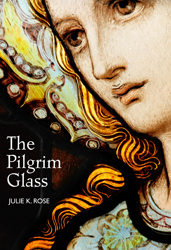
Book Giveaway - The Pilgrim Glass by Julie K. Rose


Author Julie K. Rose immerses booklovers in the colorful word of medieval stained glass repair, with her lauded debut novel, The Pilgrim Glass. Set predominantly in Vézelay, France, the novel begins as Jonas Flycatcher receives a call from UNESCO, inviting him to restore a fragile image of the Magdalene in ancient Romanesque cathedral of Saint-Marie-Madeleine de Vézelay. Three days later, Jonas arrives albeit without his luggage and restoration tools in a quaint village, once associated with medieval pilgrimages from ancient Burgundy to Compostela, Spain. It boasts a cathedral famed for its relics of Mary Magdalene. Jonas must restore the stained glass within a few short weeks, in time for the feast of the Magdalene.

Jonas meets the worldly Abbot Michel Dubay. The men initially clash over intrusive questions from Abbott Dubay and alterations of the original contract but Jonas soon begins his work. A comfortable partnership evolves between the two, as Abbott Dubay hints at an enigmatic past, including unclear reasons for choosing the priesthood instead of becoming an academic. Elsewhere, haunting words and images occupy the photographer Meredith’s mind, memories that cannot be her own. She seeks the comfort of friends like Marie-Laure, an expert on the region’s history. But Meredith cannot escape her visions or the pull of the cathedral. When she meets Jonas, they don’t immediately warm to each other, but eventually find common ground in their working interest in the cathedral. Their relationship surprisingly grows and changes, yet Meredith’s continuing hallucinations cause a strain on all the characters.

The central characters are memorable for their characterizations and the mysteries surrounding them. The author keeps you guessing about the sources of their pain and self-loathing throughout the novel. Why does Jonas, a renowned artisan keep everyone at bay and smother his innate brilliance in a haze of cigarette smoke? What should the reader make of Abbott Dubay’s constant reliance on the Confessions of St. Augustine, and the photograph he keeps tucked away between its pages? Why is Meredith tortured by otherworldly visions?

The setting is as realistic as the characters’ interactions, enhanced by Ms. Rose’s visit to the great cathedral at Vézelay. Scenes and descriptions pull the reader into the story, as it unfolds as though on a movie screen, rather than pages. This is an easy, enjoyable read. In particular, I admired the author’s references to pigments, vivid shades of red and blue that colors the world around Jonas.

A semifinalist in the 2009 Amazon Breakthrough Novel Award, The Pilgrim Glass is an entertaining, surprisingly suspenseful read, and I highly recommend it to readers who love historical mysteries enhanced by authentic details. As I told Ms. Rose, she’s gained a fan and I look forward to her future work.

Please leave a comment to win a free, signed copy of The Pilgrim Glass, and thanks for visiting the blog.


Wednesday, December 8, 2010

Troubled Water: Race, Muting, and Bravery on the USS Kitty Hawk


Troubled Water

Race, Mutiny, and Bravery on the USS Kitty Hawk

Author: Gregory A. Freeman

Reviewed by: L. Gregory Graham

Imagine sitting in your bunk in a labyrinth of decks, passageways, and work areas that make up the underbelly of an aircraft carrier as gang warfare rages out of control around you. You know nothing for sure, but you hear that black radicals in the crew have taken over the ship and killed the captain. You’ve read news stories where reporters claim the Black Panthers are looking for ways to sabotage the war effort. Shouts echo up and down the corridor, and you sweat in the tropical heat wondering who is in charge of the ship and if rampaging blacks will choose to storm your compartment next.

This is not a techno-thriller dreamed up by a writer; this is historical fact. It happened aboard the USS Kitty Hawk at the shank end of the Vietnam War. Gregory Freeman does a masterful job of allowing the reader to walk beside the captain, the executive officer, and crewmembers as an aircraft carrier, the pride of the modern Navy, is overwhelmed with a race riot, and possibly a mutiny.

Troubled Water is a blow by blow description of how bad things can get when a perfect storm of bad policy, an unpopular war, extended deployments, and the Civil Rights movement turn a ship into a crucible mirroring the unrest in civilian society.

The narration is well balanced, a difficult task when your subject is race and the Vietnam War. There is ample opportunity to take sides, but the author does not. Was institutional discrimination against blacks a problem in the Navy at that time? Yes. Were recruiters lying to black and white kids alike about career opportunities in the Navy? Yes. Had the Navy set its standards too low to get warm bodies aboard ship? Yes. Was the Navy allowing blacks, whites, and Chicanos to self-segregate aboard ship? Yes. Did the blacks avail themselves to the proper channels to get their grievances out? No. Would it have ameliorated the situation? Questionable. Did the rampaging blacks go after the wrong people? Yes.

We see the captain’s side of events. He knows his job is to keep the ship on line and launching aircraft on missions over North Vietnam. He takes steps to protect the planes and to break up the rioters. We see the executive officer’s side of the event. He quickly decides that this is a race riot, and that it must be stopped at all costs before there is loss of life or aircraft. He takes radical, decidedly unnavy steps to quell the riots. We also see the black enlisted men’s side. The Navy lied to them to get them aboard the carrier, gave them the worst jobs on the ship, did not explain to them that all seamen spent their first tour on the mess deck, and denied them advancement on the basis of their lack of education, and low test scores. In addition, the Navy keeps delaying the Kitty Hawk’s deployment home because, you guessed it, other aircraft carriers are having racial problems.

You cannot read the narration without feeling sympathy for the captain who is white and the executive officer who is black. They both do what they can with the information they have available facing a unique situation. There is no section in any of their procedure manuals marked ‘Race Riots’. Unfortunately, two excellent careers are ruined as a result. Both careers grind to a halt in the face of a Congressional Investigation by congressmen with staffs who criticize their actions on the basis of hindsight and complete knowledge of the situation. One cannot help but wonder how the Navy manages to prosper when it is so determined to rid itself of such good men.

One question that I do have is where were the other officers aboard ship? The narration gives the impression that only the captain, the executive officer, and the officer in charge of the Marine attachment responded to the riots. If that is the case, then perhaps the captain should be criticized for not using the resources he had at hand. The other possibility is that the roles of other officers were minimized to keep other careers from crashing and burning on the rocks of the riot. The lack of involvement by other officers makes the narration feel incomplete. The executive officer spends a great deal of time defending the infirmary from attack. Would there be an officer in charge of that area, and would he be down there defending it also?

This book is also a measure of how far things have come since. I am sure that an aircraft carrier is still labyrinth of testosterone crazed nineteen-year-old men of all races, but the Navy has learned how to handle them now. The signs of racial tension are divined early, and steps taken to ameliorate the problem.

The aftermath is nearly as troubling; the congressional hearing concluded that ‘they could find no instances of racial discrimination that could have justified the Kitty Hawk riot’. Although, unofficially, the Navy recognized the ‘simmering discontent among black sailors and showed the some of their anger was justified because of how they were recruited and how they were treated in the Navy.’ Obviously, change did happen, but apparently it was important that the Navy make it look like it was their idea.

I would recommend this book to anyone who is a student of the Vietnam War, race relations, or the Navy. It encapsulates a very difficult time for the Navy and for society in general.

This book is non-fiction and can be purchased from:

Amazon
Barnes and Noble
Borders

Sunday, December 5, 2010

Solitaria by Genni Gunn


At an abandoned villa in Fregene, Italy, a seaside town on the Adriatic near Bari, a work crew accidentally unearths a body. Tests identified the gun-shot riddled body as that of Vito Santoro, a man presumed immigrated to Argentina decades earlier, and missing since the 1950’s. The news rocks the Santoro family.

As the family gathers from all corners of the world, its matriarch, Piera, locks herself in her room and refuses to speak to anyone other than her nephew, David, from Canada. She is the only one who knows the circumstances surrounding Vit’s death. To David, Piera slowly begins to reveal the family secrets of the past.

With flashbacks to post-war Italy, David learns about the hard luck life of the Santoro family – the unfaithful father, a mother in the throes of depression, and of their children, each of whom struggles towards adulthood desirous of their own needs. Slowly, through Piera and David’s conversation, he learns the darkest of family secrets, about love a love unrequited, and his true bloodlines.

This story captivates the reader from the very first pages. Told, with vividness and emotion, while being rich in its simplicity and ripe with emotion, this dark mystery unfolds slowly, entrancing the reader, luring them to its shocking ending. The novel explores poverty and human failure, vice and love, incest and death. It is a deeply intellectual story, moving and fulfilling.  I highly recommend it.   

The author, Genni Gunn, is of Italian roots, having been born in Trieste and having travelled extensively throughout Italy. Therefore, readers can be assured of the authentic Italian feel within the story concerning cultural and historical issues of the time. Ms. Gunn has been a finalist for the prestigious CBC Literary Awards, has published nine books: three novels, including Tracing Iris, which is being made into a film, and numerous short stories and poetry collections, one of which was a finalist for the Gerald Lampert Award. But, her talents do not end there. The author has also produced an opera, Alternate Visions, which premiered in Montreal in 2007. Her poem, “Hot Summer Nights,” was turned into classical vocal music and has been widely performed all over the world.


For more about Genni Gunn, I encourage you to visit her website at: Genni Gunn

Wednesday, November 3, 2010

Heidegger's Glasses by Thaisa Frank


Review by Sheila R. Lamb


 Heidegger’s Glasses is a complex, intricate story that weaves history with the esoteric. By using philosopher Martin Heidegger’s eyeglasses as a catalyst, Thaisa Frank questions the definition of reality within the historical framework of World War II Germany. 

Cocooned from the blatant horrors of World War II, Scribes and their SS guards are equally imprisoned in an underground compound, built within a mineshaft. The job of the captive Scribes is to answer letters to the dead in order to appease their otherworldly spirits, who would otherwise tell the world about the Nazi plan for the Final Solution. Based on the historical existence of the Thule Society and the Nazi officers who subscribed to occultist beliefs, Frank extends their ideas to create the fictional Compound of Scribes.

Elie Schacten is one of the Scribes, a group of bilingual translators forced to write letters to the dead. Elie and her lover, SS guard Gerhardt Lodenstein, are members of the Resistance, and use the Compound of Scribes as a hiding place for refugees.  Elie’s true identity remains shrouded in layers of mystery, much to Lodenstein’s dismay.

When the feared Nazi propaganda leader Goebbels orders the Scribes to write a letter and deliver eyeglasses to philosopher Martin Heidegger from his optometrist friend Asher Englehardt, held at Auschwitz, the clandestine world of the Scribes is turned upside down. Neither Englehardt nor Heidegger is dead and the Scribes openly question the bizarre nature of their entire mission. Suddenly, their personal dramas meet the harsh face of Auschwitz as Lodenstein ventures beyond the compound to follow the Reich’s orders. Elie and Lodenstein must protect the Scribes, and the Resistance, from Goebbels’s unpredictable wrath.

Thaisa Frank writes with clear-cut prose, deftly juxtaposes the horror of war and the tenderness of love. Heidegger’s Glasses asks, in the face of war and death, what is real?

Wednesday, July 21, 2010

What is Left the Daughter by Howard Norman

What is Left the Daughter
By Howard Norman
Reviewed by L. Gregory Graham

Why do some families appear to attract an unusual share of bad luck and woe while others sail through life piling achievement upon achievement? The author tries to answer that question in the rocky wind swept village of Middle Economy in Nova Scotia during World War II when German Uboats patrol the waters of Eastern Canada sinking what boats they can.

What is Left the Daughter is a story of a boy marked for life by the suicides of his parents on the same day. Both jump to their deaths from separate bridges in Halifax, Canada. The story is the interplay between the heart and the mind when disaster is heaped upon disaster in the course of one young life.

Does one recover from something like that? In this case, the answer is no. His life is colored by the sepia tones of that tragedy. Wyatt Hillyer, the protagonist of the story, moves to the village of Middle Economy to live with his aunt and uncle. It is a village where the women are emotionally stronger and saner than the men. It is also a village where anyone who leaves to improve their lot in life fails. He starts a new life, makes friends, falls in love with Tilda, the adopted daughter of his aunt and uncle, is spurned, and foolishly helps his uncle dispose of the body of his murdered brother-in-law.

When he returns to Middle Economy after prison, he fathers a child named Marlais by Tilda. He loves them dearly, but Tilda and Marlais move to Denmark to live with the parents of her murdered husband.

The book takes the form of a long letter to Marlais who has decided to return to Canada now that her mother has died. Wyatt tries to explain himself, and why he has not tried to visit or even contact her for twenty years.

Self-reflection is not a strong point in Wyatt. He catalogs his long days working as a detritus collector in Halifax Harbor. He accepts his lot in life. He lives in transient hotels, goes to movies, and lives a small careful life devoid of self-improvement or ambition. Wyatt loves his daughter, but never makes any attempt to see her or contact her.

We are left with the question why? Wyatt tells us that he thinks the ghosts of his parents are with him always. They whisper in the static on the radio. Does he fear that his bad decisions will imprint on Marlais if he contacts her the way his parents’ decisions imprinted on him? Or is he merely content with the small rut of a life he has carved for himself in the rocky damp soil of Nova Scotia? Has he judged himself in some cosmic balance, and deemed that this is the only life he deserves? We never know for sure.

This book asks some tough questions, and then supplies only incomplete answers. Is Wyatt a hero in the sense that he refuses to pass on the legacy of his parents and his own bad decisions? Or is he so self absorbed in penance for his own misdeeds that he cannot reach out to his own daughter? And finally, why does he feel it necessary to contact her now that she has decided to return to Canada? Does he wish to tell his side of the story now that Tilda can no longer filter it, or before she hears it from the folks of Middle Economy?

In the end, what is left to Marlais? Her legacy appears to be a very long letter and a very timid father.

Monday, July 12, 2010

The Waste Land by Simon Acland


“The abbey awed me; it was in itself the largest town I had seen, ringed by a thick wall broken by occasional narrow windows, with the houses of the village scattered around outside. By the wall loomed the skeleton of a building greater than I had dreamed possible, clad in wooden scaffolding. The ribbed bones of huge arches made me think of the great fish which had swallowed up holy Jonah. The entrance was guarded by a solid gatehouse. It squatted on the walls with menace. I realised that it hunched there as much to close the inhabitants in as to keep strangers out. Above the gates was carved the Clunaic coat of arms – two large keys crossed over a single heavenwards pointing sword. It pictured to me an uncompromising message: ‘here forever you will be locked away from your childhood knightly ambition.’
– Hugh de Verdon, The Waste Land

In The Waste Land by Simon Acland, the Master of a nearly bankrupt college needs to improve the institution’s finances. Enter a former student, now a Best-Selling Author and the Research Assistant with a timely solution: the novelization of an ancient manuscript. The turbulent life of Hugh de Verdon, a would-be knight errant unfolds on this timeworn parchment, which seems to predate the unfinished work of Chrétien de Troyes, on Perceval and the grail. Each of the college’s administrators has a keen interest in the manuscript, much to the Best-Selling Author’s dismay. When their concerns conflict, it soon becomes clear that one person among them is less keen on the adaptation of Hugh’s fascinating story, and perhaps is willing to kill his academic rivals to prevent its publication.

As Mr. Acland takes the reader from the contemporary world of the college to the high Middle Ages, likewise Hugh moves between the secular and spiritual spheres of the world, often questioning the ideals and realities of both arenas. Orphaned and disinherited in his childhood, he enters the Benedictine abbey at Cluny, seemingly consigned to a monkish life forever. Yet his natural curiosity soon takes him beyond the abbey walls, as Pope Urban II announces the holy Crusade to retake Jerusalem and the surrounding cities from the Muslims. Now in the service of Duke Godfrey de Bouillon, Hugh journeys on his own quest to become a knight, resolve the doubts surrounding his faith, and find the woman he loves. In a strange encounter with a mysterious Old Man of the Mountains, Hugh undergoes a life-altering change and learns some of the answers he is seeking lie in his past.

Whether in the depiction of Hugh’s loneliness at Cluny, or the gory battle scenes of the First Crusade, Mr. Acland excels at showing Hugh’s development. Each scene and location is remarkably detailed, and the historical figures are equally fascinating. In particular, I enjoyed the characterization on Hugh’s overlord Godfrey, as a lusty, battle-hardened leader; often shown in contrast to his conniving brother Baldwin de Boulogne, who usually serves to frustrate Godfrey’s plans. Hugh’s first-person narration ensures that the reader experiences the full range of the character’s emotions and thoughts, and a deeply personal view of his perspective on the Crusade. I won’t spoil the ending, but it entirely fits the theme of a grail romance. Hugh’s journey continues in the sequel, The Flowers of Evil, due in 2011.

Friday, July 2, 2010

Book Giveaway: Clan by David P. Elliott


“Suddenly Elliot shuddered, just as he had when they first arrived at the cottage, but this time the temperature drop was accompanied by a strong feeling of nausea and a feeling that something was clenching at his heart. His vision was blurred and he felt faint. Suddenly his body was soaked, as he broke out in a cold sweat, reminiscent of his night terrors. Sweat ran from his hairline into his eyes and through his blurred vision he saw a hooded face looking at him from one of the windows.”

If you enjoy Scottish history, with a good dose of the paranormal, David P. Elliot’s Clan revels in both. The author is skilled at depicting and manipulating myriad emotions, with his vivid descriptions and powerful characterizations.

As Clan opens, a great medieval battle unfolds between two giants, William Wallace, of Braveheart fame, and William de Soulis, lord of the ancient Hermitage Castle. Both men survive and while Wallace goes on to the fate history has recorded, de Soulis’s life takes him in a different, and far more dangerous, direction. Centuries later in 2007, David Elliot, three times divorced and now jobless, contemplates his dreary past and the bleak outlook for the future. His daughter Kate convinces him to take a much-needed vacation with her husband Simon and their son Thomas, in the Newcastleton area, once home to generations of his clan, the Elliots. It was also the scene of hundreds of years of border strife between the English and Scots, as both sides fought for the Scottish throne.

Unexpected events and meetings with strange characters convince David that his journey is more than a simple getaway, but an opportunity to deal with the demons of his past, bring meaning to his dissolute life, and discover the power of love and family. Though separated by centuries, his fate is on a direct collision course with the will of William de Soulis, who reaches from the dark recesses of the past to reclaim his birthright and the destiny his enemies have kept from him.

Clan met all my expectations for a good read, but I was truly impressed at how well the author handled the various scenes, juxtaposed from differing points of view. In addition to Elliot and his family, the author also introduces us to Andrea Dettori, the shady leader of the Soulis Foundation; Thomas Truman, a seemingly harmless old man, with ties to Elliot’s past, and other engaging characters. I was engrossed throughout the chapters and had to pace myself and just enjoy the story as it unfolded.

I’m not one to scare easily, but the paranormal scenes especially spooked me, and I felt no shame in confiding to the author that I refused to read the book at night. In addition to the violent, soulless villains, the author introduces some of the most depraved and vicious creatures to ever terrorize on the page, called Red Caps. Whenever one appeared, I expected a bloody mess and the author always delivered.

Clan is currently available in several countries and has been featured at the Hawick Museum and the Liddesdale Heritage Centre in the Scots Borders.


PLEASE LEAVE A COMMENT TO WIN A COPY OF CLAN, AND VISIT US FOR AN INTERVIEW WITH FEATURED AUTHOR, DAVID P. ELLIOT.

Tuesday, June 15, 2010

29: A Novel by Adena Halpern

On the day of her 75th birthday, Ellie Jerome blows out the candles on her cake and wishes to be 29 years old for one day. When she awakes the next morning, her body is firm and youthful, there are no wrinkles on her face, she can see clearly, and her hair has no traces of gray. It takes her a while before she truly comes to believe that her wish came through. Unsettled by what has happened, she soon comes the realization that this is a “once-in-a-lifetime” opportunity and she must seize and make the most of this one special day.

With the help of her granddaughter, Lucy, Ellie is determined to reach out and experience everything she can. First, she gets a new hairstyle and then dons a spectacular new gown.  When she looks in the mirror, she can scarcely believe that she is the youthful beauty reflected therein.

As she maneuvers through her special day, a gift beyond her wildest dreams, she attracts oodles of attention and soon finds herself in the arms of a handsome young man.

While Ellie is enjoying her new freedoms, Ellie’s daughter and her best friend are worried about her and desperate to find her and make sure she's safe.  Meanwhile, Ellie begins to understand the meaning of life and learns powerful lessons about the true value of a husband, family, friendship, and comes to appreciate the wisdom that can only come with age.

At times hilarious, and at other times sad, this chick-lit novel is truly an entertaining read. Duty, family, and tradition conflict with modern social freedoms to make this tale not only hilarious and engaging, but poignant. Adena Halpern does a marvelous job of giving the reader insight into the thoughts and behaviors of three generations of women in the various stages of life. A definite fun summer read for women of all ages.