Thursday, August 12, 2010

Review of the Personal History of Rachel Dupree

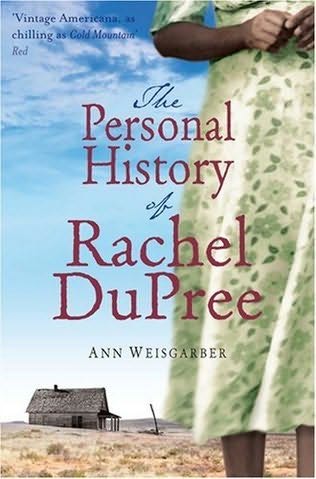
The Personal History of Rachel DuPree is a story best experienced firsthand with fingers pressed to the pages and an uninterrupted stretch of time. I found myself unwittingly drawn in by narrative that’s so direct and familiar in tone, it’s as if Rachel herself were speaking to me. Even the most subtle passages are deeply moving and the clarity of the simplest details brings Rachel’s world fully to life. But there’s far more to this book than time and setting. This is as much a story of race and the ambition to better one’s self, as it is about courage in the face of adversity.

Twenty-five year-old Rachel, a kitchen maid in a Chicago boarding house, agrees to marry Isaac DuPree, the son of a doctor’s widow. Although she barely knows Isaac, Rachel admires his ambition and believes that together they can build a better life. Newly wed, they leave to hew out a living on a ranch in the dusty wilderness that is the South Dakota Badlands. Negroes in the West are rare and Isaac is determined to build his wealth in land and earn the respect of others. Despite the toll inflicted on them by their harsh environment, Rachel bears a quiet fortitude as she tries to live up to Isaac’s expectations. But sometimes with sacrifice comes suffering and Rachel and her family are no exception. Hunger and thirst are all too familiar and death an often unwelcome guest. As their neighbors abandon their lands, Isaac clings ever more fiercely to his dream. Meanwhile, Rachel struggles to ensure her family’s survival, while alternately longing for the comforts of her old Chicago home. Without a doubt, Rachel DuPree will take her place among America’s literary heroines.

The Personal History of Rachel DuPree enlightens us to the tenacity of the pioneer spirit, the stark realities of life in an unforgiving land and the sometimes cruel truth about how the West was really won. Ann Weisgarber captures the otherworldly landscape and harsh climate expertly – so much so that you can feel the grit under your fingernails and the dryness in your mouth long after you close the book. This is a poignant tale that will move you in unexpected ways, as it pits hope and pride against reality and resourcefulness.

Not only did this shoot to the top of my list of all-time favorites in historical fiction, but it easily takes a spot among my favorites of any genre. If I’m asked to recommend one must-read book for the year, The Personal History of Rachel DuPree is definitely it.


Wednesday, August 11, 2010

Book Giveaway - The Personal History of Rachel Dupree


Ann Weisgarber's debut novel, The Personal History of Rachel DuPree, was named Best Work of Fiction by the Texas Institute of Letters, longlisted for the Orange Prize and shortlisted for The Orange Prize for New Writers. Set in the early 20th century Badlands of South Dakota, it is a story of one woman's struggle to defeat adversity and give her children a better life.

To win a copy of The Personal History of Rachel DuPree, please leave a comment and contact information on any of the blog posts about this book between Aug. 11th and 14th, 2010, stating why you would like to read this book. The winner will be announced on August 15th.

Visit Ann's website.

Tuesday, August 10, 2010

The Purples by W. K. Berger

Reviewed by: L. Gregory Graham

I love this book because it is not history. The Purple Gang in Detroit in the 1920’s was a rough crowd in a bare-knuckle city. They specialized in killing anyone trying to muscle in on their rum running empire. Hardly fertile ground for a novel about people coping as best they can in a hostile world. The gang made millions running booze across the Detroit River from Canada during Prohibition. What this book is instead is a fictionalized remembrance by Joe Bernstein, the head of the Purple Gang. He tells his side of the story glossing over the nasty stuff and making his climb to the top of the Detroit underworld seem logical. In many ways, he casts it more as a career move than anything else.

How did it all start? Supposedly Henry Ford’s Jew hating minions had his girlfriend arrested and committed to an insane asylum. Her crime? Passing out union material at a Ford plant. When Joe leans on the local prosecutor to free her, he finds himself cut up, and thrown into the Detroit River by gangsters who owe the prosecutor a favor. He survives, but barely. Then the killings begin.

Joe surrounds himself with a motley crew of castoffs and social misfits whose talents include intimidation and murder. I swear I went to high school with some of these characters. Joes casts them more as problem solvers than as amoral murders. With his leadership, his brother’s brains, and an inner circle of talented hit men, Joe should be happy ruling his lucrative empire. Alas, he isn’t. His girlfriend comes out of the insane asylum truly crazy, his brother and his chief hit man hate each other, and Joe can’t seem to keep his men from making unsanctioned hits.

Joe manages to keep it all together until a one legged war hero/prosecutor comes to town. Using honesty, compassion, and psychology, tools Joe has no defense against, the prosecutor pits the gang members against each other and gets the convictions he needs.

There are no villains in this remarkable book. Joe is likeable because in many ways he is an American rags-to-riches story. His thugs are scary, but likable because the reader understands them and tolerates them in the same way that you tolerate your weird uncle at Thanksgiving as long as he doesn’t get too strange. Even the war hero/ prosecutor who could have come across with all the wit and charm of an obsessed comic book crime fighter had the insight to marry a warm, charming wife who spends most of the book softening the edges of his flinty character.

Joe is an imperfect narrator at best. He has a genius for manipulating people, but at the same time he is blind to the emotional damage he is wreaking on himself and those around him. His girlfriend dies by her own hand, and he orders the execution of his two best friends leaving him more isolated at the end of the book than he ever was at the beginning. Throughout the story, Joe maintains himself as a hard man living a hard life while subconsciously he seeks the love and approval of others. In fact, the book becomes his justification for his life.

At the end of the book, an Italian gangster supplies the only introspection Joe manages to take to heart. The mobster gives him the reason why the Italian mob survived when the Purple Gang did not. Your people were ashamed of you, he tells Joe, while the mob is looked upon as a career choice among Italians. Shame scatters the Purple Gang once Joe goes to prison. The Detroit Jewish community will not take them in.

Read this book because it is fun. W. K. Berger does a wonderful job of capturing the wide-open feel of the roaring twenties when money is as plentiful as the speakeasies, when radio announcers become the first media stars, and when Henry Ford runs Detroit as surely as any mobster does. Burger captures the spirit of the city when it is small enough to walk around and when the whole city administration can easily fit into a gangster’s hip pocket. Read it because the author does the impossible. He creates a gang novel devoid of stereotypes. The gangsters aren’t slang talking, out-of-control thugs in pinstripe suits. Their girlfriends aren’t simpering flappers. The police aren’t stupid, and the prosecutor isn’t a political hack interested in running for mayor.

Just don’t read this book as history.

Monday, August 9, 2010

Book Giveaway: The Crown in the Heather by N. Gemini Sasson

Thanks for joining us. Gemi has graciously agreed to give away a copy of her wonderful book, The Crown in the Heather. Leave a comment and tell Gemi what you find most fascinating about her main character, Robert the Bruce. She will pick the lucky winner and send you an autographed copy of the book. In the meantime, enjoy this excerpt of The Crown in the Heather.


An ebbing tide pulsed against the shoreline of Rothesay’s broad-mouthed bay. Elizabeth and I walked side by side, my fingers brushing her forearm, pebbles crunching beneath our feet. A pair of tracks stretched in an erratic trail before us: one set the loping paw prints of a young, long-legged dog in full stride and the other Marjorie’s small, closely spaced footprints where she scampered after him. Seagulls, picking over spilled catch, exploded in a cloud of fulmination, then dove menacingly at the exuberant hound pup. Marjorie covered her head with her arms and let out a screech of terror. At once, Coll bounded in her direction and leapt into the air, his teeth gnashing at the clap of beating wings. Rolling in laughter, Marjorie sought out another petulant flock and repeated the game.


In the distance, fishing boats cluttered the sloping shore. There, fishermen were busily unloading the workday’s yield before darkness descended over the island. The day, although sharply cold, had been unusually calm and sunny for January. Above the silver-black waters of the bay, the peaked rooflines of Rothesay crowded against a deepening blue sky. Inland, snow-topped domes contrasted with the vermilion hues of a sinking sun.

Elizabeth stumbled and I grabbed her by the arm to steady her.

“Careful of your step, Lady Elizabeth.” I tucked her hand within the fold of my left elbow, the fingers of my other hand gently clasping hers. “Perhaps you would prefer to walk on my right, away from the water . . . before you fall in?”

She raised her oval chin, her lips pursed tight as if feigning indignity, and drew her shoulders back. “You presume I’m clumsy, my lord.”

“No, I—”

“Well, I’m not, I assure you. I was merely watching Marjorie and her dog playing. Otherwise, I’m quite surefooted.” She winked at me. “As nimble as a cat.”

I fought a grin. “And when you tumbled to the floor last night during the dance?”

She slapped the back of my hand playfully. “Are you mocking me, Lord Robert? Perhaps I should stay closer to you, like this,”—she swung herself around to stand before me—“so you may catch me in your arms next time? Would you?”

For a moment, I forgot myself. Forgot it was past supper and we were overdue at table. Our absence would raise brows. I hardly cared. It was rare we were ever together like this without a crowd of onlookers ogling our every gesture and eavesdropping on every innocent word.

Her fingers wandered up my arms teasingly. “Would you?”

“Would I what?”

“Catch me . . . if I fell?”

A movement distracted me and I glanced up to see Oonagh hobbling toward Marjorie, who stood near the boats waving her arms at the seagulls. In all likelihood, Oonagh had been sent to beckon us back to the castle for the evening meal. In time. I was neither hungry yet nor willing to join the crowd in the hall. I gazed down at Elizabeth, fascinated by the way one of her rounded brows was set higher than the other and the spattering of freckles across her slender nose. I hungry yet nor willing to join the crowd in the hall. I gazed down at Elizabeth, fascinated by the way one of her rounded brows was set higher than the other and the spattering of freckles across her slender nose. I slid my hands around her waist and drew her to me until I felt the slight pressure of her hips against my thighs.

“Like this?” With a sudden heave, I swept her off the ground, one arm snug around her back and the other cradling her legs.

I expected a shriek of protest and an upbraiding; instead, she tossed her head back, laughter bubbling from her throat, and kicked her feet in the air. She reached an arm around my neck and I swung her in a circle: sky and sea and mountains blurring into a streak of shadowy blue and steel gray around us. Not until the ground pitched beneath me did I stop. My knees wobbling, I planted my feet wide and clutched Elizabeth closer to my chest to keep from dropping her.

“Shall I put you down now?” I asked.

Thank you, Gemi. Don't forget to leave your comment to win a copy of the book.

Sunday, August 8, 2010

Review: The Crown in The Heather by N. Gemini Sasson


The Crown in the Heather – The Bruce Trilogy: Book I by N. Gemini Sasson


“Whenever we want something, we must weigh the cost of getting it. A farthing is a fair price for a loaf of bread. Two shillings for a yard of wool. But what price will a man pay to be his own master?”

This question is at the heart of N. Gemini Sasson’s debut, The Crown in the Heather – The Bruce Trilogy: Book I, and it is the primary concern driving the central character of Robert the Bruce. Heir to the earldom of Carrick, Robert grows up headstrong and impulsive. Under the tutelage of his grandfather and father, he learns to negotiate the politics of thirteenth-century Scotland. Yet he yearns to be more than one among many Scots held in the sway of the English King. Robert wants to be the ruler of a county free from the severity and abuses of its nominal leaders. His ambition is a direct threat to England and several of the Scottish nobles, who refuse to rally around his claim.

As Gemi says in her Author’s Note, folklore sometimes defines the truth of what we know about a character. Robert the Bruce has taken on an almost mythical status over the centuries, like that of King Arthur. I enjoyed so much of Gemi’s portrayal, but foremost is that her Robert is a devoted son and brother, a loving husband and father. He is also a king passionately dedicated to the preservation of his people and their country. Where he wavers in his devotion, is when his own ambitions endanger the lives of those whom he loves most, particularly his wife Elizabeth and daughter Marjorie. I could feel the struggle inside of him, thanks to Gemi’s skill. He became so real to me, conflicted by his desires, wanting the stewardship of his nation despite an easy temptation to capitulate and surrender the burden. His quest for the crown of Scotland almost guarantees that he will never have the comforts of home. Moments of joy with his wife and daughter are fleeting, snatched in brief interludes before threats arise. Robert’s passion for Elizabeth, like everything else about him, is larger than life. Varied historical figures complete the cast of the Crown in the Heather, most notably William Wallace of Braveheart fame; the nemesis of the Scots, King Edward I of England and his beleaguered heir, Edward of Caernarvon; John the Red Comyn, a one-time Guardian of Scotland like Wallace, and a host of other characters.

One among them truly stands out: James Douglas, whose story parallels Robert’s own. He is in danger of eclipsing Robert as the hero of this story. James suffers losses early on, followed by a cruel exile in Paris. His experiences toughen him, but his innate goodness defies his otherwise wily behavior and a tendency to rush to confront his enemies. If I can liken the Bruce to King Arthur, then James Douglas is his Lancelot. It is only in the latter half of the book that James becomes one of the more trusted members of Robert’s retinue, but he easily proves himself a capable fighter and constant companion. His portrayal left me so captivated that I promised Gemi I would just wait for Book II, rather than rushing off to learn more about him and his ultimate fate.

I have had the pleasure of working with Gemi for a few years through critique groups, and from the start, she amazed me with her natural ability to convey human emotions, as deftly as a professional artist sketches landscapes. Her characters are vibrant and resonate beyond the pages of the book. Gemi has earned my respect and admiration for her enthusiasm and dedication to perfecting her work. It was a tremendous honor and pleasure to read the final version of The Crown in the Heather. I eagerly look forward to more on Robert the Bruce and his faithful cohort, James Douglas, in Book II.

Tomorrow, win a free autographed copy of this book. Visit us again at Historical Novel Review.


Book: Kindle:

Friday, August 6, 2010

The Red Queen by Philippa Gregory

The Red Queen by Philippa Gregory is the second book in the Cousins of the Cousins War series.  It is the tale of Margaret Beaufort, the mother of Henry Tudor who was later crowned King Henry VII and who began the long line of Tudor kings. She is also known as grandmother to the infamous Henry VIII.

The story opens with Margaret’s childhood. She is a pious child, deeply intrigued by Joan of Arc with the abounding desire to enter a monastery and rule as abbess. Typically, children of the nobility were slated for political alliances and Margaret was no exception. As the cousin of King Henry VI, she was wed to his half-brother, Edmund Tudor, with the expectation of creating an heir to the thrown for the House of Lancaster. A son is soon born to them and he is named Henry. Margaret experiences a prophetic dream which tells her that he will be King and this unleashes a powerful sense of protection and ambition within her.
 

With her son still an infancy, tragedy strikes and Margaret finds herself suddenly widowed. Almost immediately, she is married off to Henry Stafford, son of the 1st Duke of Buckingham. She is torn away from her son who is left in the guardianship of Jasper, her deceased husband’s brother to whom she bears a great affection. Although their marriage was harmonious, the couple remained childless and she soon found herself widowed once more. This time, the now wealthy widow takes matters into her own hands and approaches Thomas Stanley, Lord High Constable, for a marriage alliance. The calculating, conniving lord readily accepts and they enter into a loveless marriage of convenience.

At the forefront of the story is the War of the Roses, the infamous battle between the Yorks and Lancasters. To preserve her son’s claim to the thrown, Margaret must circumnavigate treacherous political alliances, murder plots, and rival queens. Throughout, Margaret is portrayed as manipulative, shrewd, ambitious, and even callous. And although readers may not like her, she was very much a woman of her times, forced to survive in an ever-shifting world fraught by wars and death.

In The Red Queen, popular British author, Philippa Gregory, pays homage to a lesser known, unpopular woman of English history. Gregory’s portrayal of this villainess was compelling and credible, a challenge when the main character is more of an antagonist than a protagonist. The first person narrative added powerful insight into Margaret Beaufort’s actions and motivations. Although I have yet to read The White Queen about Elizabeth Woodville, her rival in the War of the Roses, I recommend reading both books to get a feel for the opposing viewpoints of these two rival women. This novel is a refreshing change from the over abundance of Tudor novels on bookshelves. Its brilliance lies in the easy style of writing Gregory employs to tell a complex political tale of fiction filled with numerous characters, well-researched, believable, and larger than life.

As a long-time Philippa Gregory fan, I was eager to read this newest novel scheduled for release this month, August 2010. I very much enjoyed reading this novel and look forward to reading The White Queen. Doing so will provide insight into both points of view in the infamous War of the Roses.

Monday, August 2, 2010

The Price of Glory by Seth Hunter

I am delighted to introduce you to The Price of Glory by Seth Hunter. It is the third and last book of the series, which features Nathan Peake, the young English Captain with American roots. The previous titles were The Time of Terror and The Tide of War.

Captain Nathan Peake commands the Unicorn, a frigate of the Royal Navy. He is sent to intervene in France’s revolutionary war by his Navy command. England's engagement is based on loyalty to the French king; however, Nathan will find out that the struggle for the leadership in France is in truth one about power and money.

Besides all duty, Nathan secretly looks for his love Sara who was swept away by the surge of the revolution. England's plan to support the French royalists comes handy for the young, determined Captain. Sadly, his first assignment fails, and he must fear consequences. Instead, he is sent on a secret mission to Paris, right into the heart of the revolution. Soon, he is entangled in the web of foul intrigues, brute forces, and licentious indulgence. Unintentionally, he sets Napoleon Bonaparte on his way. Having redeemed himself in London, he is allowed to return to the command of the Unicorn. He joins Captain Nelson's fleet which rushes to thwart Napoleon's plans to invade Genoa. Only now, Nathan finds an opportunity to slip away to visit a secret meeting place to see whether Sara is still alive. At the end of his quest, he'll find help from an unlikely place.

Author Seth Hunter
Once again, Seth Hunter manages to weave an action filled tale into the fabric of historical events of revolutionary France. The inclined reader is introduced to celebrities of English and French history alike. As the tension rises, there is a touch of humor, a certain laissez-faire in the tale that provides relief. Captain Nathan is a likable man, who does not always succeed. Not Mr Perfect at all and maybe that makes him so real. The language is easy to read but not simple, naval idioms are cut to an easy-to- understand level, and the frequent change of scenery provides enough opportunity to add atmosphere.

The series will appeal to adventure loving readers, but will disappoint the romance lover. If you enjoy adventures written from a male perspective, and maybe are interested in that time frame (1795) then you will find The Price of Glory to be a very enjoyable read.