Showing posts with label 15th Century. Show all posts

Wednesday, November 23, 2011

Through an Icon's Eyes by Grace Conti

Brilliant from start to finish – you must read this hauntingly beautiful story!


Overview

Set in 1440s London, Italy and Greece against a turbulent political background enflamed by religious divisions, the unfolding narrative of Benedict Paston and Annie Carter's relationship encompass memories of heresy, murder, loss and betrayal.


Benedict an erstwhile sundial maker, is lost to the world. His self-imposed exile, both emotional and physical, in a remote Greek monastery is relieved only by the task of painting an icon under the monks' instruction. Their hope: to save his tortured soul. As the hours of devotion mark the progress of one day in his monastic cell, an escape from Benedict's self-destructive isolation is brokered by the image of Mary Magdalene, guiding him back to his previous life and a new understanding of the events that have led him to Greece
.
Annie, a young widow beset by visions and facing death, finds that she too has an unusual guide and confessor as the light and shadows mark the progress of an English day in a very different cell…

My Review

I get very, very excited when I discover a novel, so wonderful, so enjoyable, that I include it on my list of lifetime favourites. Set in the 15th century in an ancient abbey, Through an Icon’s Eyes by Grace Conte fits that bill exactly!

This is a beautifully written story, so engaging, so engrossing, I could not put it down. One of the main characters is a partially-completed icon of Mary Magdalene who comes alive in the painter’s mind acting almost as a conscience for him – guiding, questioning, enlightening. Bit by bit, the story spirals into spectacular events of heresy, murder, lust, and betrayal that culminate into an utterly satisfying, completely shocking ending. Extremely real, three dimensional characters that are ever evolving enchanted me from the very first page. Each page is ripe with wisdom, teases with mystery, and swirls the reader into a hurricane of emotions.

Grace Conti is extremely talented and the beauty of her prose is a joy to read. The author is donating all the proceeds to breast cancer research until Christmas 2011. That in itself makes it worth buying and I encourage everyone to do so. Better yet, the book would make a wonderful gift. Brilliant from start to finish – you must read this book.
Share/Bookmark

Thursday, November 17, 2011

Thwarted Queen by Cynthia Haggard

An indepth historical biographical novel of Cecily Neville


Synopsis

THWARTED QUEEN is a portrait of a woman trapped by power, a marriage undone by betrayal, and a King brought down by fear.

Cecylee is the apple of her mother’s eye. The seventh daughter, she is the only one left unmarried by 1424, the year she turns nine. In her father’s eyes, however, she is merely a valuable pawn in the game of marriage. The Earl of Westmorland plans to marry his youngest daughter to 13-year-old Richard, Duke of York, who is close to the throne. He wants this splendid match to take place so badly, he locks his daughter up.

The event that fuels the narrative is Cecylee’s encounter with Blaybourne, a handsome archer, when she is twenty-six years old. This love affair produces a child (the “One Seed” of Book II), who becomes King Edward IV. But how does a public figure like Cecylee, whose position depends upon the goodwill of her husband, carry off such an affair? The duke could have locked her up, or disposed of this illegitimate son.

But Richard does neither, keeping her firmly by his side as he tries to make his voice heard in the tumultuous years that encompass the end of the Hundred Years War - during which England loses all of her possessions in France - and the opening phase of the Wars of the Roses. He inherits the political mantle of his mentor Duke Humphrey of Gloucester, and become’s the people’s champion. The rambunctious Londoners are unhappy that their country has become mired in misrule due to the ineptitude of a King prone to fits of madness. Nor are they better pleased by the attempts of the King’s French wife to maneuver herself into power, especially as she was responsible for England’s losses in France. But can Richard and Cecylee prevail? Everywhere, their enemies lurk in the shadows.

This book is filled with many voices, not least those of the Londoners, who forged their political destiny by engaging in public debate with the powerful aristocrats of the time. By their courageous acts, these fifteenth-century Londoners set the stage for American Democracy.

Review


Thwarted Queen is a young adult novel about Cecylee (Cecily) Neville, mother to kings of England. The author did an exceptional job of portraying Cecily as strong and determined woman, unafraid to speak her mind and take risks. Although fettered by the restrictions of her era, Cecily made the most of her marriage to Richard Plantagenet, Duke of York. As she and her family becomes caught in the life and death struggles between two families vying for the throne of England, she initiates her own battles. The strong, first person narrative author, immediately engages the reader. It is evident that author Cynthia Haggard did extensive research into the life of this fascinating woman and has more novels forthcoming. A wonderful novel to introdcuce Cecily Neville and historical biographical fiction to young female readers. 


Cecily Neville was at the very top of the social scale in late medieval England, and held the highest status a woman could enjoy. She was the eighteenth child of Ralph, first Earl of Westmorland and Joan Beaufort, daughter of John of Gaunt. Her marriage to Richard Plantagenet, Duke of York, was a suitable match between two families of great status.

Richard Plantagenet
Duke of York

Besides wielding considerable political power in an age when few women did so, Cecily administered a large feudal estate, with all the interlocking duties and responsibilities, which that entailed.

Given her high rank, Cecily Neville might have been constrained by the conventional medieval noblewoman's life of piety, patronage, courtly attendance and quiet support for her husband. But she certainly did not heed the advice of the author of The Goodman of Paris (1393), a treatise on household management, who advised that to satisfy their husbands young wives should behave like faithful dogs.

Cecily was a great beauty and indulged in the luxurious lifestyle that her marriage to the wealthiest peer of the realm allowed. She also supported her husband's actions in claiming the crown at the end of the 1450s, and moved beyond the expected behaviour of contemporary noblewomen when she became directly involved in political events.

This trend continued after her husband was killed during the battle of Wakefield in December 1460. Cecily's eldest son, Edward, Earl of March, became King Edward IV in 1461.


King Edward IV

Cecily soon received confirmation of her lands and rights, and as a widow with enormous personal wealth, she continued her patronage of religious houses and the college founded by her husband at Fotheringhay, in Northamptonshire. Cecily also adopted the role of Yorkist matriarch. After 1461, her main goal became the arrangement of a suitable marriage for the king. When in May 1464 he secretly married a low-born widow, Elizabeth Woodville, instead of a European princess, Cecily reacted angrily and refused to subordinate herself to the new queen, styling herself 'queen by right'.

Elizabeth Woodville

By marrying Elizabeth Woodville, Edward also alienated Cecily's powerful nephew Richard, Earl of Warwick, known as the 'Kingmaker', who had been conducting negotiations with the French king for Edward's marriage. There is evidence that by 1469 Cecily had declared Edward to be illegitimate and, with Warwick, was pushing for the crown to pass to her second son, George, Duke of Clarence.

George Plantagent
Duke of Clarence

This development permanently damaged her relationship with Edward, so from 1471 until after his death in April 1483 she avoided the royal court and concentrated on her private interests.

When Edward died, Cecily revived her kingmaking activities. By this time her sense of dynasty was even more acute. Clarence had been attainted by the king and had died in mysterious circumstances in the Tower of London in 1478. Cecily therefore now acted decisively to restore the true Yorkist line through her youngest son, Richard, Duke of Gloucester, who in 1483 became Richard III.

Richard III
Duke of Gloucester

In support of Richard's claim to the throne, Cecily held a meeting at her London home to nullify Edward's will, and supported the assertion that his sons - the 'Princes in the Tower' - were illegitimate and so could not rule if the Yorkist dynasty was to remain pure.

Subsequently, in August 1485, Richard was defeated by Henry Tudor at Bosworth Field and died during the course of the battle. With Henry firmly installed as King Henry VII, the 70-year-old duchess gave the impression of finally accepting defeat.


Henry VII

Nevertheless, there is evidence that after her death in 1495 many of her servants were involved in the conspiracy to dethrone Henry VII hatched by Perkin Warbeck (who claimed to be the younger of the two princes murdered in the Tower). Cecily's life and intrigues show that women could enjoy considerable influence in the masculine world of medieval politics, as well as in more conventional female roles.

The above article is was taken from the National Archives

I LOVE COMMENTS
Share/Bookmark


Wednesday, November 16, 2011

The Lily and the Falcon by Jannine Corti-Petska

An engaging romance set in 15th century Florence


Bianca degli Albizzi is outraged when sworn enemy Cristiano de'Medici asks for her hand in marriage. With her father's blessing, she weds the handsome warrior to end the war between Florence's two powerful families. But headstrong Bianca vows to teach her husband that loyalty cannot be bought...not even by seduction. Cristiano, a well-known warrior with the wealth of a king, could have any woman he desires. But for the sake of peace he ends up with a defiant bride who awakens his deepest passion. Her vengeful scheming puts them both in peril, but is he prepared to sacrifice his life to safeguard the woman who has stolen his heart?

The Lily and the Falcon is the first of a four book historical romance series set in Italy. The author’s fine prose immediately drew me into the story, and the Italian setting, intriguing characters, and endearing love story definitely kept me there reading.

First and foremost, this a historical romance set in the decadence of 15th century Florence. It is a story about two lovers, Bianca degli Albizzi and Cristiano de Medici who are required to marry in order to bring an end to the long-standing feud between their two families. But things are not all that they seem and trouble soon befalls the young couple, casting doubt on their motivations and growing feelings.

I love Italian historical fiction, and this novel satisfied me very well. The author is of a strong Italian background and it is evident she has spent considerable time in Italy. Her experiences added ambience and richness to the story, making the entire novel, from start to finish, authentically Italian. I could easily visualize the palazzo and sensual descriptions that really brought this novel to life.

Suspicion, betrayal, poisonings, passion, family loyalty, and a love that surpasses all expectation fills each highly descriptive page. Well worth checking out and recommended to anyone who loves stores set in the Italian Renaissance.

Monday, November 14, 2011

The Unhewn Stone by Wendy Laharnar


Synopsis:

When teenager, Stefan Gessler, answers the call to restore his family's honour, he discovers it takes more than superior education and pride to equip him for life in the Middle Ages. His dangerous adventures threaten his courage and challenge his beliefs. Immersed in the turbulent events of the Wilhelm Tell legend, Stefan pretends to be a wizard when an avaricious sibyl mistakes him for an alchemist. The shape-shifting sibyl and an evil knight have diabolical reasons to want the wizard dead. Faced with his own demons and those of medieval Switzerland, how will Stefan complete his mission and escape the fourteenth century...alive? Life in the Middle Ages is a dangerous game, even for Üserwäälti, the Chosen One.

Review:

The Unhewn Stone, a time travel novel by Wendy Laharnar, takes us into the heart of medieval Switzerland and immerses us smack in the middle of the legend of Wilhelm Tell. Although geared towards young adult readers, the novel is written with such rich detail and seamless prose that it can be enjoyed by readers all ages. Time travel, alchemy, mystery, an evil antagonist, a mysterious books, secrets, and the passion of life and death fill each luscious page of this book. There is something for everyone in this novel, one that that transcends any one particular genre – from contemporary to historical to fantasy.

This novel is suspenseful, yet humorous at times. It is a coming of age story. From its likeable protagonist to its detestable antagonist, and the plentiful adventure and suspense in between, this is a wonderful novel to savor. Luscious prose that is simple and uncomplicated, allows the reader to slip easily into the story. Can the hero alter the past to improve the future for others? That is one of the main premises in this fascinating tale.

The author travelled to Switzerland to conduct research, so it is no wonder that the descriptions of places and her knowledge of specific events enriches this tale and truly brings it to life. The author is a talented writer whose prose is lyrical and enjoyable. This is one novel it is easy to recommend. Truly a delightful, heart-warming read!

Sunday, October 30, 2011

The Borgia Betrayal by Sarah Poole


As befits the story of a poisoner for the infamous BorgiaPope Alexander VI, Sarah Poole’s TheBorgia Betrayal begins with murder, as the protagonist forces one of the Pope’senemies to end his own life quickly. What may be unusual about this novel isthat the poisoner who deals in death so easily is a woman, Francesco Giordano.  She is an interesting heroine, operating in themale-dominated world of the Catholic Church with a reckless bravado and cunningthat matches that of the Borgias.

In this sequel to Poole’s Poison, Francesca serves the Pope’s interests as well as her own. Sheis part of a secret society called Lux, whose purpose contravenes the Church’sdogma and takes great risks to keep Lux and its members safe. Her activities donot escape the Pope, who uses her as a pawn to draw out one of their mutualenemies, Bernando Morozzi. He threatens the Pope’s hold over Rome, but moreimportantly, he is responsible for the death of Francesca’s father. Francescadevises a bold plan to draw out her father’s killer, placing her own life in thebalance.

Francesca’s daring earned my admiration for Ms. Poole’stalents as a writer, but there were times where I questioned the wisdom ofcertain actions. It seemed almost as if the heroine had a death wish, yet shefought so valiantly at the end of the story. While I had difficulty reconcilingsome of the extremes of her personality, Francesca is a memorable character andI hope to read more of her adventures in Ms. Poole’s novels.     

Sunday, October 16, 2011

The Lady of the Rivers, Philippa Gregory


Jacquetta has heard that her family is descended from the water goddess Melusina. She has heard that this genealogy is what has given the women in her family the ability to see the future. But, she’s also heard that using this “sight”, and even merely possessing it, is a crime punishable by death.

Nevertheless, one surprising day Jacquetta receives an explanation of and training in how to use the sight. Not everyone has it, and her family knows that honing it is the most important thing for those who do. After all, only by honing it can the owner hope to survive.

Not everyone is unfamiliar with Jacquetta’s gift, however. One fateful evening, the Duke of Bedford and Jacquetta meet, and that encounter serves as the turning point in Jacquetta’s life. After marrying the Duke and becoming the Duchess of Bedford, Jacquetta is surprised to find that her new role in life is less focused on being a wife than on using her sight to predict the future of England’s war with France.

When her husband dies unexpectedly, Jacquetta is surprised to find that her life at the English court affords her freedom as well as the ability – nay, need - to avoid using her sight. She is put to service in the young queen, Margret of Anjou’s, household. She soon finds, however, that her life is not destined to consist solely of work. Before she knows it, she is married to Richard Woodville and the mother of several children.

For readers familiar with Tudor history, Jacquetta is none other than the mother of the woman who would become Richard IV’s so-called “commoner queen”: Elizabeth Woodville. In her most recent work, Philippa Gregory focuses on the mother of one of the most controversial queens, wife of one of the most revered warriors of his time and also the woman who followed her heart and created a home filled with the love and laughter of which she always dreamed.

Jacquetta is the perfect subject for Gregory’s extremely accurate and engaging intellect and writing skill, and Gregory shines in all 435 pages of The Lady of the Rivers. The novel itself flows with descriptions of the multiple lives the heroine led as well as the knowledge, instinct and keen interest to understand the world around her that made her one of the most revered, and sometimes feared, women of her time. The wording, tense plot and portrayal of other characters of the period evoke images of the novel that first catapulted her to our world, The Other Boleyn Girl. With its delicious twist and turns, The Lady of the Rivers is a must-read for all historical fiction aficionados.

Monday, October 10, 2011

The Lady of the River by Philippa Gregory

The fascinating story of Jacquetta, Duchess of Bedford.
The woman who navigated a treacherous path through the battle lines in the Wars of the Roses.


Back Cover Blurb:

Descended from Melusina, the river goddess, Jacquetta always has had the gift of second sight. As a child visiting her uncle, she met his prisoner, Joan of Arc, and saw her own power reflected in the young woman accused of witchcraft. They share the mystery of the tarot card of the wheel of fortune before Joan is taken to a horrific death at the hands of the English rulers of France. Jacquetta understands the danger for a woman who dares to dream.

Jacquetta is married to the Duke of Bedford, English regent of France, and he introduces her to a mysterious world of learning and alchemy. Her only friend in the great household is the duke’s squire Richard Woodville, who is at her side when the duke’s death leaves her a wealthy young widow. The two become lovers and marry in secret, returning to England to serve at the court of the young King Henry VI, where Jacquetta becomes a close and loyal friend to his new queen.

The Woodvilles soon achieve a place at the very heart of the Lancaster court, though Jacquetta can sense the growing threat from the people of England and the danger of royal rivals. Not even their courage and loyalty can keep the House of Lancaster on the throne. Henry the king slides into a mysterious sleep; Margaret the queen turns to untrustworthy favorites for help; and Richard, Duke of York, threatens to overturn the whole kingdom for his rival dynasty.

Jacquetta fights for her king, her queen, and for her daughter Elizabeth for whom Jacquetta can sense an extraordinary and unexpected future: a change of fortune, the throne of England, and the white rose of York.

A sweeping, powerful story rich in passion and legend and drawing on years of research, The Lady of the Rivers tells the story of the real-life mother of the white queen.


Jacquetta of Luxembourg was distantly related to the Kings of England. When she was 17 years old, she was married to John of Lancaster, the Duke of Bedford. Their arranged marriage was to strengthen ties between England and the Holy Roman Empire. Unfortunately, their marriage was childless and her husband died a few years later.

King Henry VI of England sent Sir Richard Woodville to bring the young widow, Jacquetta, back to England, but along the way, they fell in love. Without waiting for the king’s permission, they secretly married before they arrived, risking the dower lands Jacquetta had been granted upon her first husband’s death as long as she did not marry without the king’s approval. The King was incensed and refused to see them. Wisely, the couple paid a £1000 fine to appease him. Their marriage was a happy one and over the years, Jacquetta bore Richard sixteen children, one of which, Elizabeth Woodville, would become the future Queen consort Elizabeth Woodville.


Read an Excerpt at Scribd
 
Philippa’s website
 
Simon and Schuster Book Page


Sunday, July 24, 2011

The Fabulous Voyage Across The Ocean Sea by Jay Prasad

The Fabulous Voyage across the Ocean Sea is the story of three young men who cannot escape their heritage. It offers a fascinating glimpse into the life of the Sephardim, in the period of the mass persecution and expulsion of the conversos from Spain in the late 15th century. 

It is 1486, when Miguel de Avila’s father summons him from his home in Barcelona back to his birthplace in Toledo. Miguel, a gem dealer, and his father have been estranged since the father’s affair with Miguel’s betrothed. The Spanish monarchs, Isabella of Castile and Ferdinand of Aragon have sponsored the nationwide persecution of the Spanish descendants of Jews, whose property the Crown confiscates, before Dominican friars preside at auto-da-fe rituals. The victims have two choices: to profess their devotion to the Christian faith and die by strangulation, or to continue their supposed adherence to the Jewish religion and suffer death at the burning stake.

The conversos are damned either way, something that Miguel’s experiences drive home. He witnesses one of the executions in the company of his father’s housekeeper, who takes a lustful interest in him. Later, when her guilt overwhelms her, the woman accuses Miguel and his family of being secret Jews. He and his father escape trial. Miguel undertakes his father’s last command, to find his illegitimate brother, Luis, sired on Miguel’s former betrothed. The precariousness of life as a converso makes the prospect of Christopher Columbus’ plans for a voyage to the East, via a western route, interesting to Miguel. He meets with Columbus and his brother, promising to finance a journey. He questions whether Columbus has truly found the route he promised, as the natives whom the sailors encounter are entirely unlike what they expected.

In 1493, Luis de Avila enters the court of the Catholic monarchs, as Isabella’s secretary. Christopher Columbus and his co-captain have returned to Spain at odds with him. While Luis experience some disappointment that his brother Miguel is not among the sailors who have returned from the Indies, he remains painfully aware from his childhood experiences of the instability of life for the Sephardim. Luis is eager for an opportunity to discover his brother’s fate, as Columbus plans his next voyage. His responsibilities take him back to Spain, and a new wife and son. He also finds Miguel’s own illegitimate son, Aurelio, living in an orphanage. The interference of his in-laws puts Luis’ life in danger and he flees, leaving Aurelio to fend for himself.

Aurelio de Avila is a bright boy, with a seemingly bright future ahead of him. He trains as a lawyer at the prestigious Salamanca University. One of his first tasks requires him to review the petition of Christopher Columbus for revenue he has not received from his voyages. In doing so, Aurelio learns of Columbus’s possible origins and the final fate of the man who rescued him from the orphanage. Can Aurelio escape the troubles that arise from his family’s history?

Author Jay Prasad has written a tragic and compelling story of Jewish life in 15th century Spain. The triumphs and tragedies of each of the three protagonists are vivid. The author’s portrayal of Spain during the period is fascinating and full of rich detail.

Monday, July 11, 2011

Green Skies by Andrew Oberg and Eric Uhlich

This is the story of Bjorn Thorsson and it is a grim tale and a sad one.

For the sake of their community's continued survival, Bjorn and his friends, Thorfinn and Oskar capture a live polar bear to trade with the Norwegian King for wood and iron ore. The middleman in this trade is the Bishop of Greenland, who doesn't consider the needs of his people, but only the beauty of his church. He accepts stained glass windows in trade instead. The community slides into cold starvation from the long, fuel-less winter. The story lies in how Bjorn meets his future.

I've read many comics over the years and while there have been some that wowed me on a higher critical scale (higher production values, tighter writing, etc.), I can't recall the last comic that brought me to tears.  Marvel, D.C., Dark Horse, eat your hearts out. You missed this one. Green Skies has some redundancies and pacing issues and the ending isn't entirely clear, but there's beauty and pathos here in spades and it's well worth your while. 

Thursday, June 30, 2011

The Maid by Kimberly Cutter


Back Cover Blurb:


It is the early part of the fifteenth century and the tumultuous Hundred Years War rages on. The French city of Orleans is under siege, English soldiers tear through the countryside wreaking destruction on all who cross their path, and Charles VII, the uncrowned king, has neither the strength nor the will to rally his army. And in the quiet of her parents’ garden in Domremy, a twelve-year-old peasant girl, Jehanne, hears a voice that will change her life – and the course of European history.

The tale of Jehanne d’Arc, the saint and warrior who believed she had been chosen by God to save France, and who led an army of 10,000 soldiers against the English, has captivated our imagination for centuries. But the story of Jehanne – the girl – whose sister was murdered by the English, who sought an escape from her violent father and a forced marriage, who taught herself to ride, and fight, and lead, and who somehow found the courage and tenacity to convince first one, then two, then tens, then thousands to follow her, is at once thrilling, unexpected and heart-breaking. Sweeping, gripping and rich with intrigue, betrayal, love and valour. The Maid is an unforgettable novel about the power and burden of faith, and the exhilarating and devastating consequences of fame.


Joan of Arc

From Bloomsbury Publishing comes an exceptional novel about the life of Joan of Arc. 


Of all the stories I've read and all the movies I've watched about the life of Joan of Arc, this novel is a most superb rendition of her life. The author's strong third person narrative filled with vivid details and emotions, truly gave me an insight into this heroic woman's very soul. Realistic and heart-wrenching, I could not help but savour every page of this fabulously, well-written novel. Although the story is about a Saint who receives messages and hears voices sent from God, the religious/Christian feel was subtle and did not overpower the story.   

The personal willpower and strength of the heroine truly impresses. The author did an exceptional job at depicting Jehanne's convictions despite the prejudices against women during this era. For a young peasant girl to gather an army of military warriors and gain the attention of the king, makes for a poignant story that not only makes the reader rejoice, but grieve at the injustice suffered. 

This book has it all - a beautifully written glorious tale of a courageous young woman facing insurmountable odds and her success with tragic results. A must read! 

Friday, April 15, 2011

Tom Fleck by Harry Nicholson


Reviewed by: L. Greg Graham

Every once in a great while the lucky reader finds a book that he wants to go on forever. Tom Fleck is such a book. A good historical novel takes the reader into a world that he knows little of and allows him to walk around in someone else’s life. A very good novel makes the reader want to live there. This novel transports the reader to the windswept pastures and fens of northeast England at the time of the Battle of Flodden. At first, 16th century England appears to be a well ploughed field until you discover that Henry VIII and his many wives assert no royal prerogatives here, and Elizabeth launches no fleets of plucky Englishmen to fend off the Spanish Armada. Instead, we live with common men trying to survive one of the bloodiest battles in English history.

This is the story of a landless cowherd working the less than bountiful lands of a minor lord in the north of England. His goal in life is to own a few acres so that he can pasture his own cattle and live in a house with a roof that does not leak on him and his sister. What are his assets? He’s a pretty good shot with a longbow, he has a gold piece that he dug out of an ancient burial mound, and he has a dog that does a good job of running down rabbits and retrieving them. I have no intention of summarizing the plot. Why spoil the fun of going along with Tom on his ride up to the borderlands?

I will say however, that I have always held a fascination for the borderlands between England and Scotland during the 15th and the 16th century. In many ways, these people are much more the cradles of American democracy than any documents signed by King John at Runnymede. The attitudes these northerners hold are the same as those found in America a century later: advancement should be based upon skill and drive rather than on birth right; the absolute rejection of the belief that one’s station in life is determined at birth; self reliance, and a general distrust of authority.

Harry Nicholson could easily have set this story on the frontier in 18th century America. He wouldn’t have even had to change the names. Those border clans basically peopled America over the next century bringing with them their drive and spirit.

Nicholson’s descriptions are exquisite. His love for the land comes through on every page. This novel is practically a tribute to the landforms, the fauna and the flora of northeast England. The author treats the reader to the trills of the larks, and the ‘pee-wit’ cries of the plovers. We see the forget-me-nots, the speedwells, and the eyebright that grow along the lanes. During the Battle of Flodden, the author takes the time to describe a covey of partridge scared up by the sound of the cannon fire and the look of the trampled wild irises growing along a creek the day after the battle.

The author depicts everyday life. Lords and ladies are mentioned only because they must be, but the author’s eye is ever on the common people. Tom meets good and bad folk. The soldiers are not faceless extras. They are conscripts far from home who must fend for themselves. For them battle is a scary, brutal business where few are lucky to survive unharmed. Tom, on the eve of Flodden, recites his version the soldier’s lament that he fights for master’s he does not like against men he does not hate for a cause the means nothing to him.” Apparently nothing has changed over the centuries.

I would recommend this book to anyone who appreciates a good adventure about people that don’t usually have their story told. I wish Harry Nicholson good luck on this novel, and I truly hope it is the first of many.

Monday, March 28, 2011

Sins of the House of Borgia by Sarah Bower

The Renaissance court of Lucrezia Borgia comes to life in this epic tale of the wickedly corrupt Borgia family.


Sins of the House of Borgia is an epic historical fiction novel of the infamous Borgia family who rose to power in fifteenth century Italy. The story is narrated by a young Jewish girl named Esther who is forced to leave Spain when the Jews are expelled. She flees to her father in Italy who uses her for his own political advancement. He urges her to relinquish her Jewish faith and be baptized as a Catholic in order to place her as a lady in waiting for Lucrezia Borgia. Lucrezia stands as Esther’s godmother.

Lucrezia Borgia

The illegitimate daughter of depraved Pope Alexander VI, Lucrezia Borgia’s court is one of decadence and secrets. Violante soon encounters the alluring and callous Cesare, Duke of Valentinois and Romagna, Lucrezia’s old brother, and falls desperately in love with him.

Cesare Borgia

After a horse race, Cesare renames her Violante, breaker of promises. As the relationship with Cesare progresses, Violante relinquishes her virginity to him, which resulted in two unanticipated results - she becomes pregnant and contracts a dose of the pox.

The world has always been fascinated with the wickedly corrupt Borgia family and many books have been written about them. What makes this novel stand apart is that it is told through the eyes of an innocent Jewish woman trapped at the center of numerous intrigues. As a result of her connections to the Borgias, she is caught up in the family’s troubles, forfeits all family ties, and suffers great losses.

Sins of the House of Borgia is a riveting, scandalous historical fiction novel with shocking characters and an intricate plot. The book is rich in detail, the times brought to life skilfully and with accuracy. Sarah Bower skilfully draws her readers into the abundantly vivid world of Renaissance Italy. This opulently gratifying story immerses the reader into the rich lives of the characters. It is a dazzling, breathtaking read – one worth savouring, which I very much recommend.

Sunday, March 13, 2011

Poison In The Blood, by M G Scarsbrook


Although the name Borgia is well known for their power hungry and decadent lifestyle, little is known of Lucrezia, the daughter of Rodrigo Borgia, Pope Alexander VI. She was certainly a pawn in her father’s quest for power, in that he married her off to three different members of European nobility in order to advance his political ambitions. She was also thought to have had an illegitimate child by a lover. However, the extent of her complicity in the political machinations of her father and brothers is unclear. 

Contemporary accounts say Lucrezia had heavy blonde hair which fell past her knees, a beautiful complexion, hazel eyes which constantly changed colour, a full, high bosom, and a natural grace. Although I doubt anyone in 15th century Italy would have dared describe the Pope’s only daughter as ‘homely’.

History says Cesare Borgia suffered from syphilis and to cover his scars wore a mask and dressed in black. Insanely jealous of her second husband, Alfonso of Aragon (Duke of Bisceglie) when the Prince visited them in Rome, Cesare's men attacked him during the night. To retaliate, Alfonso's men shot arrows at Cesare while he strolled in the garden. This infuriated Cesare, and he had his servant strangle Alfonso while in the recovery room. Lucrezia and Alfonso had an infant, Rodrigo, who predeceased his mother in August 1512 at the age of 12.

It is this marriage and Cesare’s hatred of Alfonso that Matthew Scarsbrook’s Poison In The Blood deals with in a fast paced and very readable way. His Lucrezia is a young and relatively innocent girl with a conscience, whose father rejected her mother when she was small, and whom she is forbidden to see. Lucrezia's betrothal to Alfonso of Aragon is arranged by her family, but she determines to be a good wife. To her horror, Lucrezia discovers her brother Cesare, keeps a locked room full of deadly poisons and that he also murdered their elder brother Juan, who received honours and privilege Cesare believed were due to him.

When Pope Alexander and Cesare go on campaign to defeat their enemies, they leave Lucrezia behind to keep the cardinals of the Vatican in order. Lucrezia seeks advice from Nicollo Machiavelli, the philosopher and poet, and performs well, but she is also aware that when her men return, Alfonso’s days are numbered.

She plans to escape from Rome before the assassins strike, taking their infant son, Rodrigo with them and beg for shelter from Alfonso’s estranged family. However, Cesare pre-empts them and returns early, inviting them to a feast which Lucrezia is convinced will be Alfonso’s last.

Despite her careful arrangements, Alfonso is poisoned and lies near to death. His only hope of an antidote is the legendary Mithridate, but the formula has been lost. Undeterred, Lucretia goes looking for this miraculous antidote and is reunited with her mother.

Just when I was at the point of deciding this Lucrezia was a little too virtuous, her Borgia ancestry emerges and she persuades Cesare to spare her husband’s life in exchange for the formula for Mithridate which she has memorised.

In Medieval Rome, beauty, decadence and luxury hide murder and betrayal. Lucrezia’s fight to keep her husband alive is conflicted by the love she has for her brother, a twisted, dangerous man who may not be acting entirely alone.

I thoroughly enjoyed this portrayal of an ancient story and anyone who enjoys Medieval Italy, love, betrayal and a strong, resourceful heroine on a knife edge, will enjoy this well researched and well written book.

Saturday, January 8, 2011

The King of Silk by Joe Douglas Trent


The King of Silk by Joe Douglas Trent


Michael Patriate is a rising star in the business world. His knowledge and shrewdness have taken him into the most powerful offices and boardrooms of New York City. As he occupies himself with merging two powerful corporations and gracing the pages of the world’s most respected finance magazine, his personal life is falling apart. The woman he loves has left him. One dark night, as he walks alone through a deserted street in Manhattan, he is mugged and assaulted and falls into unconsciousness.

When he awakes, he finds himself in a strange world, one that is completely foreign to him. As he encounters people, he comes to the realization that the year is 1492 and he has somehow travelled to Renaissance Italy in the area of Caorle. With nothing of value except for his wristwatch, which is more of a danger to him than an aid, Michael is utterly alone and must fend for himself. Armed with his business acumen, he soon finds himself a job working for a merchant. Soon, he takes over the bookkeeping for the small business and teaches his new boss knowledge from the modern world. Soon he finds himself travelling to Venice, trying to outsmarting a bevy of callous merchants. His knowledge attracts attention at the highest levels. Even his love life improves as he falls in love with the lovely widow, Cecile, who he boards with.

The King of Silk is a fascinating story about a man armed with modern knowledge who is forced to explore the world centuries ago. Michael is a congenial hero thrust into an impossible situation. As the reader progresses through the novel, they are swept into the dangers and realities of a treacherous world. The book is well written and edited. The prose is clear and the story is easy to follow. Numerous colourful characters that Michael meets as he journeys to Venice and later Portugal, keep the reader engrossed in the story, turning pages to find out what happens next. For anyone who loves time travel and Italian historical fiction, this book is definitely a well-researched winner.  But you'll have to wait to read it.  The book is scheduled for release early in 2011.  Watch for it on Amazon or visit the author's website at: http://www.jdtrent.com/

Thursday, October 28, 2010

The Queen of Last Hopes by Susan Higginbotham


A Review by Judith Arnopp


In 1445, aged fifteen, Margaret of Anjou was married to King Henry VI of England, a marriage intended to restore peace between France and England. When Henry declined into madness eight years later, the heavily pregnant Margaret was drawn to the forefront of English politics. In stepping from her prescribed feminine role to oppose the claims of the Yorkist faction she became a target for enemy propaganda. Her fierce protection of her son, Edward of Lancaster, and her refusal to admit defeat did not attract acclaim, as would have been the case had she been a man, instead she was accused of a variety transgressions.

Since the Wars of the Roses Margaret of Anjou has been seen as a vengeful, violent figure. Shakespeare presented her as an adulterous bitch whose natural female instinct for nurture was corrupted to homicide. Later historians and novelists have taken this opinion of Margaret and run with it and in numerous works she appears as a virulent, unnatural woman, a ‘she wolf’ meddling in the affairs of men. Recently, however, there have been revisions of Margaret’s character, a reassessment of her actions and a more balanced, detached view of her is emerging.

Susan Higginbotham’s novel, The Queen of Last Hopes, is spawned of this revisionist opinion. The tale is told from a Lancastrian perspective, multi-narrated by Margaret herself and various members of her retinue.
Although meticulously researched Higginbotham’s Margaret is, for me, unconvincing. In trying to negate the slander I feel the character emerges as ‘too nice for words,’ as my mum would say. Recorded instance of brutality are glossed over or excused and so she emerges almost as saintly as her husband, King Henry.
I also found that, in many areas, Higginbotham’s research gets in the way of a good story. I wanted to feel blades slicing through flesh, the horror of cousin fighting cousin, the raw, tearing grief of losing a child. Instead the trauma of Margaret’s experiences seem twice, even thrice removed. I did not hear her voice and received instead an anaesthetised account.

On the whole I found the male characters more convincing. The Duke of Somerset, Henry Beaufort, slightly rakish, foolhardy, is likeable because of his flaws and a far more comfortable read than Margaret. King Henry’s complex mix of confusion, religious dedication and loyalty makes him a likeable king, touchingly naive. And Margaret’s son, Edward of Lancaster’s honest narration and unfortunate end is just as well rounded and his death painfully poignant.

I appreciate the amount of research that Susan Higginbotham has put into this novel. Most novelists have approached the Wars of the Roses from a Yorkist point of view, I believe and I like the refreshing Lancastrian perspective. I admire the way Higginbotham dispenses with the propaganda against Margaret but, for me, she shines just a bit too brightly to be real. Also in ignoring the vilification against Margaret it would have been good if she could have done the same with the slanders that the Tudors levelled against the Yorkists but instead, many of the old defamations of Richard of Gloucester and Edward IV remain.

On the whole it is a solid, entertaining read, a little less historical detail and a little more blood and sweat would have improved it for me but, there, I am a bloodthirsty girl. The Queen of Last Hopes is a winner and will please Higginbotham’s fans and attract new readers from the adherents of the Lancastrian faction.
For more information on Susan and her novels go to http://www.susanhigginbotham.com/

Friday, August 6, 2010

The Red Queen by Philippa Gregory

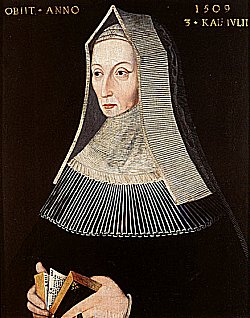
The Red Queen by Philippa Gregory is the second book in the Cousins of the Cousins War series.  It is the tale of Margaret Beaufort, the mother of Henry Tudor who was later crowned King Henry VII and who began the long line of Tudor kings. She is also known as grandmother to the infamous Henry VIII.

The story opens with Margaret’s childhood. She is a pious child, deeply intrigued by Joan of Arc with the abounding desire to enter a monastery and rule as abbess. Typically, children of the nobility were slated for political alliances and Margaret was no exception. As the cousin of King Henry VI, she was wed to his half-brother, Edmund Tudor, with the expectation of creating an heir to the thrown for the House of Lancaster. A son is soon born to them and he is named Henry. Margaret experiences a prophetic dream which tells her that he will be King and this unleashes a powerful sense of protection and ambition within her.
 

With her son still an infancy, tragedy strikes and Margaret finds herself suddenly widowed. Almost immediately, she is married off to Henry Stafford, son of the 1st Duke of Buckingham. She is torn away from her son who is left in the guardianship of Jasper, her deceased husband’s brother to whom she bears a great affection. Although their marriage was harmonious, the couple remained childless and she soon found herself widowed once more. This time, the now wealthy widow takes matters into her own hands and approaches Thomas Stanley, Lord High Constable, for a marriage alliance. The calculating, conniving lord readily accepts and they enter into a loveless marriage of convenience.

At the forefront of the story is the War of the Roses, the infamous battle between the Yorks and Lancasters. To preserve her son’s claim to the thrown, Margaret must circumnavigate treacherous political alliances, murder plots, and rival queens. Throughout, Margaret is portrayed as manipulative, shrewd, ambitious, and even callous. And although readers may not like her, she was very much a woman of her times, forced to survive in an ever-shifting world fraught by wars and death.

In The Red Queen, popular British author, Philippa Gregory, pays homage to a lesser known, unpopular woman of English history. Gregory’s portrayal of this villainess was compelling and credible, a challenge when the main character is more of an antagonist than a protagonist. The first person narrative added powerful insight into Margaret Beaufort’s actions and motivations. Although I have yet to read The White Queen about Elizabeth Woodville, her rival in the War of the Roses, I recommend reading both books to get a feel for the opposing viewpoints of these two rival women. This novel is a refreshing change from the over abundance of Tudor novels on bookshelves. Its brilliance lies in the easy style of writing Gregory employs to tell a complex political tale of fiction filled with numerous characters, well-researched, believable, and larger than life.

As a long-time Philippa Gregory fan, I was eager to read this newest novel scheduled for release this month, August 2010. I very much enjoyed reading this novel and look forward to reading The White Queen. Doing so will provide insight into both points of view in the infamous War of the Roses.

Thursday, May 6, 2010

Highland Blessings by Jennifer Hudson Taylor

The story opens with the death of Bryce MacPhearson’s father in the Highlands of Scotland of 1473, who entreats his son to make him a promise that he hopes will end a half century of feuding between his clan and the MacKenzies.

In an effort to carry out his vow, warrior Bryce kidnaps Akira MacKenzie on her wedding day with the intention of marrying her to his reluctant elder brother, Evan. However, the timing is not ideal, for it is Akira’s wedding day to Gregor Matheson, although Bryce cannot know that Akira has already renounced her prospective groom. Dragged off on Bryce’s horse, Akira is horrified to learn she is intended not for the man who kidnapped her, but for his brother, Evan MacPhearson.

Humiliated, Akira fights Bryce and the two enter into a resentful but grudging alliance when through his carelessness, she almost drowns. He takes her home to recover, but then Akira learns Evan has little intention of marrying a MacKenzie and her humiliation is complete.

Akira forms a bond with the MacPhearson deaf-mute younger brother, Sim, but then her clan enters MacPhearson land to reclaim her and in a skirmish of misunderstanding, Arkira’s prospective groom and Evan are killed.

In order to keep his promise to his father, and now Clan Chief, Bryce forces the issue by marrying Akira by proxy and presenting her with a fait accomplis. Furious, Akira refuses to accept him at first, but her feelings undergo a change when she learns more of her husband’s character. Perhaps God has given her a higher purpose in this forced marriage.

An uneasy truce exists between Bryce and Akira’s brothers, Elliot and Gavin. Then a string of murders leaves a trail of suspicion and fear, so that Akira no longer trusts anyone and worse, Bryce doesn’t trust her. Before long, Akira finds her own life is in jeopardy.

Clearly, there is a traitor in their midst who must be uncovered, or Bryce may never get past his suspicions about his wife and neither can find happiness .

Highland Blessings is a gentle story which takes a sinister twist when the plot turns to murder. Akira is a confused girl who doesn’t understand what her role is and to whom she should feel loyalty. Feeling unloved by her family, she seeks a way to come to terms with what God has destined for her. Her battles become more complicated as she falls deeper in love with Bryce.

Jennifer Hudson Taylor’s Akira MacKenzie draws Medieval Scotland very well in her characters and their motivations, beliefs and loyalties. I found her heroine more reflective and soul searching than the usual romantic heroine, but then that could be because I have never read an inspirational romance before, so her internal conflict and its conclusion have a purpose.

For those who revel in stories of Medieval Scotland and the romantic Highlands in particular, you will find empathy with Akira and her battles, both emotional and spiritual.