Showing posts with label Greece. Show all posts

Saturday, January 7, 2012

The Year-God's Daughter by Rebecca Lochlann


Review by Lavender Ironside

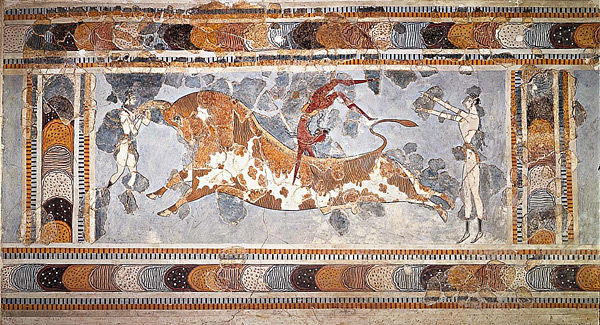
Set amongst the mystery of the Minoan Labyrinth and the heart-pounding thrill of the bull-dancing ring, The Year-God’s Daughter is the first volume of The Child of the Erinyes, a sweeping epic of a series spanning time from the Bronze Age to the near future. 

In Rebecca Lochlann’s first novel, we are introduced to Aridela, a young priestess and princess – and to the mysteries of Athene, the inscrutable goddess whose hand guides Aridela’s fate.  Aridela is the youngest daughter of the queen of Kaphtor (Crete).  She was born under portentious circumstances and has grown up revered and pampered in her mother’s palace.  She is headstrong and strangely wise for her age, seemingly born to rule – yet her meek elder sister IphiboĆ« is the heir to Kaphtor, and Aridela is pledged to a life of celibacy and service to the goddess Athene.

This novel, being the first in a long series, is largely set-up for events to come; yet The Year-God’s Daughter is packed with plenty of action.  As the groundwork is being laid for the rest of the series, the reader follows Aridela through her coming-of-age – and follows, too, the lives of the people she touches, whose fates are altered by contact with this young woman chosen by Athene: IphiboĆ«, Themiste the high priestess, Selene the foreign warrior-woman, Lycus the bull-dancer, and more fascinating characters are subtly moved like pawns on a game board by Aridela’s unknowing influence. 

Most notable on the list of characters entwined with Aridela are Menoetius and Chrysaleon, half-brothers and sons of the king of Mycenae.  They are sent on a mission by their power-hungry father to discern Kaphtor’s weaknesses so that Mycenae might take control of the rich island nation.  But both brothers soon find themselves in love with Aridela…and at one another’s throats. 

The depth of historical information in this novel will delight fans of the genre.  A surprising amount of history and archaeology has been slipped unobtrusively into the narrative.  Lochlann has clearly done an astounding amount of research into her historical setting and culture, yet she never overwhelms the reader with specifics, nor does she lecture.  The conveyance of historical facts and archaeological tidbits feels very natural, woven deftly into the dialogs and thoughts of her intriguing cast of characters.

The primary strength of this book is the writing itself, which I can only describe as sumptuous.  Lochlann has a great flair for sensory detail and fills her novel with such a wealth of sights, sounds, smells, and flavors that the reader feels absolutely immersed in the world of ancient Crete from the first page.  Reading The Year-God’s Daughter is a delicious experience – seldom have I read a historical novel with such a well-drawn setting, and the fact that this book is independently published makes the feat all the more remarkable.  The rare grammatical gaffe occasionally pulled me out of the tale, but never for more than a moment – and while I often found myself wishing I understood some characters’ motives better, I have to assume that, since this is the first in a series with extreme scope, more will be made clear as the series progresses.  In any case, the luscious sensory prose was more than enough to keep me reading,  and has left me eagerly awaiting the next installment.


Cover copy:

Crete: A place of magic, of mystery, where violence and sacrifice meet courage and hope.

Aridela: Wrapped in legend, beloved of the people. An extraordinary woman who dances with bulls.

The north wind brings a swift ship and two brothers who plot Crete's overthrow. Desire for this woman will propel their long rivalry into hatred so murderous it hurtles all three into an unimaginable future, and sparks the immortal rage of the Erinyes.

A woman of keen instinct and unshakeable loyalty. A proud warrior prince and his wounded half-brother. Glory, passion, treachery and conspiracy on the grandest scale.

What seems the end is only the beginning.

The Year-God’s Daughter:  Book One of The Child of the Erinyes by Rebecca Lochlann, published by Erinyes Press, 2011.  279 pages.  Available in Kindle, Nook, and other electronic formats.  Also available in paperback.

Saturday, January 15, 2011

Penelope's Daughter by Laurel Corona

Reviewed by Vanitha Sankaran


"I took a charred ember from the fire and, going to the hidden side of my weaving I darkened what I had woven about Sparta until it was caked in black. Sometimes from the front of the loom I stare where I know the black is hiding, imagining little holes burning through the cloth. We think we can control the story we present to the world, but the truth always lies in the background, awaiting its chance to illuminate and scar.”


Most of us have read Homer’s The Odyssey at some point in our lives. While Odysseus’ battles and harrowing experiences made for great reading, not many of us likely gave much thought to the people he left behind—his wife and son, and in Laurel Corona’s fertile imagination, his daughter Xanthe.


This is not a simple retelling of a well-read epic. Rather, Ms. Corona has turned the taken prominent characters from the Trojan War and used them to create a completely new tale. The story is told through Xanthe’s point-of-view. Using her loom, she weaves the adventures and trials of her life into a picture book tapestry. These were my favorite moments, when Xanthe literally transformed her feelings into colorful physicality.


The story is told in three parts: Xanthe’s younger days when her world is full of politics that she is free to observe; her maiden days when she hides at Helen of Troy’s court to escape those very politics in the form of suitors; and the final installation when she returns home to her family, and her father.


This book is well researched and beautifully portrayed. If you are a lover of ancient Greece, this tale will suck you right in.

Saturday, August 14, 2010

"The Golden Mean" by Annabel Lyon

The Golden Mean by Annabel Lyon takes us to Greece where we meet Aristotle, the great Greek philosopher, King Philip of Macedon, and his son, the future Alexander the Great.
King Philip of Macedon invites his friend Aristotle to tutor his two adolescent sons. Aristotle arrives only reluctantly in the Macedonian capital for he wanted to become the leader of the Academy in Athens instead. One of Philip’s sons, Arrhidaeus is mentally disabled while Alexander is a keen and kindred spirit, raised to be a warrior and king.
To his surprise, Aristotle enjoys the challenge of teaching the two boys. He works to improve Arrhidaeus life, but his main goal is to teach Alexander about balancing the power of muscle and the power of mind. Alexander should learn to use the golden mean, the balance between the extremes. However, not everybody agrees to Aristotle’s ideas of how a king should rule his country. The king is at war, and his son, the heir apparent, must prove himself worthy on the battle field. Meanwhile Aristotle fights his own war – the battle for Alexander’s mind and for his own career, because he has not forgotten his desire to become one of the greatest philosophers of all time.

“The Golden Mean” boldly explores the relationship and influence of Aristotle, a philosopher, on Alexander, a warring king. Annabel Lyons chooses first person and present tense for her prose, which may not be every reader's choice. She uses an earthy, modern voice, and she does not shy away from profanity and sensuality. The Greeks were known not only for their accomplishments in philosophy and maths but also for their down-to-earth approach on human life. The question remains how close Annabel Lyon can get into Aristotle’s mind; however, this question set aside, “The Golden Mean” provides an unique glimpse into a time in which great gods were fallible, great minds invented democracy, and great kings stretched their realm to the unknown and beyond.

Sunday, November 1, 2009

The Rage of Achilles by Terence Hawkins


The Rage of Achilles by Terence Hawkins

Perhaps one of the greatest stories ever told is that of the Illiad, the Trojan war. It has been told and rediscovered by new generations through the decades. And now, author Terence Hawkins adapts this passionate story into a powerful and compelling, in-your-face retelling.

Achilles is a legendary Greek warrior of paramount grandeur. An enigma, he is renowned for his prowess in battle, noble demeanour, cruel ruthlessness, and egotistical, sometimes outrageous, behaviour. He is Ancient Greece’s most powerful weapon.

The winds of war begin to blow when Paris, the son of King Priam of Troy, steals the not-so-virtuous wife of Menelaus, brother to King Agamemnon of Greece. The Greeks send their army to Troy to retrieve her and exact their revenge. No matter how they struggle, however, they cannot breach Troy’s resistant walls.

In the turmoil that ensues between the Greeks and Trojans, Achilles’ bride is stolen. Furious, he refuses to lend his military prowess to his army against the Trojans. Without his skill, the Greeks struggle and the Trojans, led by their mightiest warrior, Hector, gain the upper hand. Even so, Achilles continues to refuse to participate. In his stead, Achilles permits his best friend and lover, to fight on his behalf. Donned in Achille’s armour, Hector kills him. When Achilles learns of the death of his beloved friend, his grief and rage knows no bounds. Achilles enters the battlefield to retrieve the body. The Trojans worry and beg Hector to withdraw, but Hector refuses.

On the battlefield, Achilles confronts Hector, who turns and runs. Exhausted and aware of the futility of his flight, Hector stops and faces his pursuer. Achilles kills him with his sword. Still enraged at the death of his lover, Achilles mutilates and vengefully drags Hector’s body around the walls of Troy.

THE RAGE OF ACHILLES is Terence Hawkins’ first novel. Within its pages, he vividly brings to life the glory and guts of a long forgotten era. He recounts this monumental tale with grim brutality and raw, violent descriptions. Hawkins delves deep into the most intrinsic of human emotions and expounds upon them with detailed intensity and an all-too-believable reality. Not for the faint of heart, Hawkins’ novel explores war with all its smells, terrors, and blood. It is the kind of heart-pumping, edge-of-your-seat book that readers long for and diligently seek.