Showing posts with label Egypt. Show all posts

Friday, November 25, 2011

Song of the Nile by Stephanie Dray

Song of the Nile - A novel of Cleopatra's daughter and interview with Stephanie Dray!


Synopsis

Sorceress. Seductress. Schemer. Cleopatra’s daughter has become the emperor’s most unlikely apprentice and the one woman who can destroy his empire...

Having survived her perilous childhood as a royal captive of Rome, Selene pledged her loyalty to Augustus and swore she would become his very own Cleopatra. Now the young queen faces an uncertain destiny in a foreign land.

Forced to marry a man of the emperor’s choosing, Selene will not allow her new husband to rule in her name. She quickly establishes herself as a capable leader in her own right and as a religious icon. Beginning the hard work of building a new nation, she wins the love of her new subjects and makes herself vital to Rome by bringing forth bountiful harvests.

But it’s the magic of Isis flowing through her veins that makes her indispensable to the emperor. Against a backdrop of imperial politics and religious persecution, Cleopatra’s daughter beguiles her way to the very precipice of power. She has never forgotten her birthright, but will the price of her mother’s throne be more than she’s willing to pay?

Review

Song of the Nile is the much-anticipated second book of a trilogy based on the life of Cleopatra’s and Mark Anthony’s daughter, Selene. This novel, however, easily stands on its own and it is not necessary to have read the first book in order to fully enjoy this one, but you’ll definitely want to collect all three books in the series.

As queen of Mauretania, Selene continues her efforts to reclaim her mother’s throne of Egypt. Like her mother before her, Selene is a shrewd young woman and must use her wits against the cunning strategies of Caesar.

Author Stephanie Dray did a splendid job of recreating Selene from vulnerable young woman to woman of great strength. The characters are complex and intriguing, at times likeable and at other times detestable. And that’s what made them so believable. Although the novel closely follows historical facts that are known about Cleopatra Selene, the author has believably filled in what was missing with vibrant detail and additional conflict that truly brings the story to life.

Delicious prose, an exotic setting, and a heroine that will impress you with her unfailing courage and determination to reclaim what was once hers, are elements that make this book worth reading. It is historical women’s fiction at its finest and I recommend you get both Lily of the Nile and Song of the Nile so you can follow the trilogy from start to finish.

An Interview with Author Stephanie Dray


1. Welcome, I'm so glad to have this opportunity to chat with you. Can you share with my readers the essence of the story you've penned?

Thanks so much for having me here. The honor is all mine!

Song of the Nile is the story of Cleopatra’s daughter, a little girl who was orphaned and taken away from the only home she’d ever known, marched through the streets of Rome as a captive prisoner, and raised by the very people who killed her family. That she was able to carve a future for herself out of that horrific past, by endearing herself to her parents’ enemies and keeping quiet about her true feelings, is a testament to her strength. However, it also meant that she was deprived of a true voice most of her life. I try to give that voice back to her.

2. You've chosen a very interesting title. What inspired the title? What inspired the book?

The original title for this book was Sorceress of the Nile because I wanted to get across that the Romans were so suspicious of Egyptian magic and they feared it in the hands of a woman. My heroine is as feared for her association with magic as for her actual wielding of it. The publisher thought the title was too much like fantasy, so we changed it to Song of the Nile which is just as appropriate because Egypt sings to my heroine and tries to lure her home.

3. What makes this book special to you?

This is a book that delves deep into the human heart and goes very dark places. Cleopatra Selene lost so much in her life--she suffered unimaginable tragedies by the time she became a bride at just fourteen years old. Exploring how it is that she was able to put her life back together to become one of the greatest queens in the ancient world was truly an honor for me. And an inspiration.

4. What makes this a book that people MUST read and WHY?

I think Selene’s story will help every woman find her own inner goddess to guide her. Moreover, Selene’s story is a lesson to us that the progress of women’s liberation has not been a straight line; there have been setbacks in the past and there may be setbacks in the future. We should be wary of them even now.

5. What sparks your creativity? Any tips to help others spark their own creativity?

Reading books! I learn so much from how other writers have tackled problems that I’m always inspired. Also, meeting with other writers at conferences always leaves me ready to go.

6. What has been the biggest stumbling block in your writing? Can you share some tips to help others get past similar problems?

This book was difficult for me to write for a couple of reasons. The first reason was that I knew it was going to be controversial; it’s darkly beautiful. I’m exploring cultural issues that would have been normal for Selene, such as slavery, rape and incest. But these things shock the modern senses. And they should shock us. But we have to know where we came from to understand where we are. I had to just swallow my fear and let some like-minded readers see the early drafts of the book so that I could have more confidence in what I was doing. Having that early feedback that this book was stronger than the first...that helped me persevere. The second reason it was difficult for me is that it is such an emotional story. To create this character, I had to channel her a little bit. I had to imagine how difficult and painful her life might be. I cried more than once writing this novel, but by the end, I was also filled with joy.

7. Tell me about the most unusual things you have done to promote your book?

Oh, the crazy things I’ve done! I suppose the wackiest is that I started making Egyptian-themed jewelry to give away with my books.

8. Each author is different in the way they create a work of fiction. Please describe for us how you plan or plot a story.

For starters, I create a giant timeline of known historical events. Then I stare at the timeline a lot, as if I can divine a pattern from it. I ask myself what themes suggest themselves from the historical record. Is this a time of recklessness when people are making fatal mistakes? Is there a slow and steady march to power? What’s the arc of this person’s life and can it be twisted into a story that follows any kind of journey? When I stared at the timeline of Cleopatra Selene’s life, I saw that it was inextricably wound up with Augustus. She lived at his sufferance. She ruled for his pleasure. But all the while, she did these little things to assert her independence and to memorialize her dead. She commissioned coins honoring her dead mother that could have created trouble for her with the emperor. She built temples to her forbidden goddess. She named her son after her lost dynasty. This suggested to me a woman who suffered from survivor’s guilt, so I used that to start filling in the holes in the historical record.

9. Authors are very unique in the way they write, the tools they use, when they write, etc. Please describe a typical writing day for you? How do you organize your day?

I use two tools for historical fiction. The first is a timeline program called Aeon Timeline and I’m desperately glad for it because math has never been my strong-suit. This program helps me keep track of the ages of my characters when certain things are happening--not to mention the events themselves. The second program I use to write is called Scrivener. It allows me to keep all my notes and research in one convenient place. I’m so dependent on it, I’m not sure I could write without it anymore! As for the structure of my day, it used to be that I’d get up, get coffee, start writing and not stop until I’d hit my word count. Lately, marketing and promotional activities have started to get in the way. I wake up, take care of urgent emails, figure out if there are any outstanding obligations I might have--books to send out, people to thank, tweets to send, etc. This takes up far more time than it should and I’m recently considering whether or not simply withdrawing into hermit land would not be a better approach.

10. What is your current work in progress?

I’m in the midst of writing the third and final book in the Nile trilogy about Cleopatra Selene’s life. This will cover the meat of her career as a successful ruler, all her amazing accomplishments, not to mention her legacy as a mother and as the last Ptolemaic queen. It’s also my last chance to say goodbye to her, so it’s been fairly emotional writing it.

11. Can you tell us where to find more information about you and your books and how readers can reach you?

I really hope readers will subscribe to my very infrequent, but always informative newsletter. I like to include recipes from ancient history, little known facts, recent discoveries about women in history, and the occasional update about my books. Also, I give out free stuff to subscribers every time I send out the newsletter and who doesn’t want free books? If folks want to find me online, however, I tweet as stephaniehdray and I’m reachable through my website at StephanieDray.com.

I love when folks stop by and tell me their thoughts on my books.

12. What would you like our readers to know about you and your writing?

My style is very allegorical. I take the historical record, then I infuse it with mythology. I do this because even though history is interesting all on its own, I want to make sense of these events for their symbolic import. This is why readers will find themes such as the divine feminine sprinkled throughout my work and why fantasy elements creep into an otherwise faithful historical narrative.

Thanks so much for having me here today!

About Stephanie…

Stephanie graduated with a degree in Government from Smith, a small women’s college in Massachusetts where–to the consternation of her devoted professors–she was unable to master Latin. However, her focus on Middle Eastern Studies gave her a deeper understanding of the consequences of Egypt’s ancient clash with Rome, both in terms of the still-extant tensions between East and West as well as the worldwide decline of female-oriented religion.

Before she wrote novels, Stephanie was a lawyer, a game designer, and a teacher. Now she uses the transformative power of magic realism to illuminate the stories of women in history and inspire the young women of today. She remains fascinated by all things Roman or Egyptian and has–to the consternation of her devoted husband–collected a house full of cats and ancient artifacts.

Berkley Trade October 2011 (Trade Paperback)
# ISBN-10: 0425243044
# ISBN-13: 9780425243046

Purchase Info

Amazon
Barnes and Noble
IndieBound
Borders
Constellation Books
Powell's


I LOVE COMMENTS
Share/Bookmark

Tuesday, May 24, 2011

When We Were Gods by Colin Falconer


Throughout the centuries, the legend of Cleopatra VII, Queen of Egypt, has fascinated and intrigued. But it has also been clouded by speculation, embellishment, and stormy controversy. Thousands of years after her death, she remains an iconic figure, an enigma; her fascinating life the fodder for numerous novels and movies. Of all the books I’ve read about this notorious heroine, Colin Falconer’s version is perhaps the most plausible and realistic version. He has struck a suitable balance between circumspect and entertainment. 


Cleopatra was born into the Ptolemaic dynasty sometime in late 69 BC – August 12, 30 BC. She was considered the last pharaoh of Ancient Egypt. She spoke Greek and later Egyptian, flaunting herself to the world as Isis, an Egyptian goddess. After the death of her father, as was tradition for Egyptian royal families of the time, she married her brothers, but after their deaths or murders, she became Egypt’s sole ruler. Her liaisons with Caesar strengthened her power and she bore him a son whom she named Caesarian.

Caesar

After Caesar’s horrific assassination, Cleopatra united with Marc Antony, handsome, powerful, and natural leader of men who loved the decadent life.

Marc Anthony

Together with Marc Antony they set out to defeat Caesar’s power hungry and ruthless nephew and heir, Octavian.

Octavian

Cleopatra bore the handsome, charismatic Marc Antony twins, Selene and Alexander.

Cleopatra and Marc Antony

But the fates brought little luck to Marc Antony and he committed suicide after failed battles. Heartbroken, Cleopatra followed him to the grave by allowing the bite of a poisonous asp to kill her.

Cleopatra by Frank Dicksee

The novel opens when Cleopatra is 18 years old at the death of her father, Ptolemy. Intrigue and danger follows as powerful men try to usurp the throne of Egypt from her. My favourite passage in the novel is the very first scene where Marc Antony is introduced. I must have read and re-read that scene no less than ten times just for the pure enjoyment. Nothing short of brilliant and so much fun! The story unfolds chronologically, realistically, and with a wonderful mix of fiction and fact. I cannot state it enough how real the story seemed and how believable the author portrayed Cleopatra to the reading audience. Her cunning and wisdom was more than adequately captured, as was her devotion to her children, her country, and her love for Caesar and Marc Antony.

The author’s writing style is direct and easy, allowing the reader to immerse themselves into the story seamlessly. Cleopatra evolves as a sensual, strong, woman trapped in a world of betrayal and the constant battle for power and supremacy. I liked this author’s prose and the way he tells a story. He worked hard to present the facts, but was able to add enough color and individuality to keep me turning and turning the pages. The level of detail made this novel real as life itself. This is the first novel I’ve read by Colin Falconer, but it won’t be the last. I’ll be collecting all of his books and will avidly follow his career from here on in. Bravo Mr. Falconer! Thank you for the pleasure of reading such a fine book. Now, off to Amazon to acquire The Sultan’s Harem.

Monday, April 25, 2011

The Lion of Cairo by Scott Oden

The Lion of Cairo: 01

The Lion of Cairo by Scott Oden

On the banks of the ageless Nile, from a palace of gold and lapis lazuli, the young Caliph Rashid al-Hasan rules as a figurehead over a crumbling empire. Cairo is awash in deception. In the shadow of the Gray Mosque, generals and emirs jockey for position under the scheming eyes of the power grand vizier. In the crowded souks and narrow alleys, warring factions employ murder and terror to silence their opponents. Egypt bleeds. And the scent draws her enemies in like sharks: the swaggering Kurd Shirkuh, who serves the pious Sultan of Damascus and Almaric, the Christian king of Jerusalem, whose greed is insatiable and whose knights are hungry for battle.

And yet all is not lost. There is an old man who lives on a remote mountainside in a distant land. He holds the power of life and death over the warring factions of the Muslim world – and decides to come to the Caliph’s aid. He sends his greatest weapon into Egypt. He sends a single man. An Assassin. The one they call the Emir of the Knife…

The strength of the book is, perhaps best demonstrated by how many “rules” Oden breaks within the first two pages and yet, you won’t be able to put the book down. The novel starts with the much-villain-ized prologue. If you're a writer, you might have heard about that rule on not starting a novel in the middle of a fight because the reader won’t know who to cheer for? Yup, he breaks that rule, too. And by the end of that four page fight scene, I couldn’t have cared less how many rules Mr. Oden broke as long as one intriguing tool – the knife – was explained.

Mr. Oden did not disappoint me in that or any other aspect of the book. In fact, he managed to surprise me.  
Oden killed off a few characters I had come to like and did not expect to die. However, their deaths have meaning and power.  Assad, the Assassin or Emir of the Knife, is probably considered an antihero in that he rejects every core value of the normal human except for loyalty to his master. He is not particularly likeable, but he is compelling. When he entered a scene, I could not put the book down until he disappeared again and because of that, I felt like I liked him by the end of the book. Would I like to meet him in an alley? No. Way. But as a character, I still can’t wait for his return.

Lion of Cairo is an amazing tapestry of faith, betrayal, loss and just a little bit of love. If you enjoy books centered around warfare and political intrigue, run, don’t walk to the bookstore and buy this one.

Tuesday, March 8, 2011

The Mistress of Nothing by Kate Pullinger

Lady Duff Gordon is the toast of Victorian London society. But when her debilitating tuberculosis means exile, she and her devoted lady’s maid, Sally, set sail for Egypt. It is Sally who describes, with a mixture of wonder and trepidation, the odd menage (marshalled by the resourceful Omar) that travels down the Nile to a new life in Luxor. When Lady Duff Gordon undoes her stays and takes to native dress, throwing herself into weekly salons, language lessons and excursions to the tombs, Sally too adapts to a new world, which affords her heady and heartfelt freedoms never known before. But freedom is a luxury that a maid can ill-afford, and when Sally grasps more than her status entitles her to, she is brutally reminded that she is mistress of nothing.
When Sarah, a lady’s maid, accompanies her ailing mistress to Egypt, they enter into a world completely different than England. As they assimilate into the culture, and shed their corsets along with some confining rules of English society, the two women become comfortable in their new surrounds. When Sally falls in love with Omar, her lady’s dragoman, the idyllic life they enjoy begins to unravel. Sally is faced with some hard decisions when she realizes she risks losing everything.

The Mistress of Nothing was shortlisted for the Giller Prize and won the Governor General’s Award for Fiction in Canada in 2009. The author travelled to Egypt for research and based her story on the real life of Lady Duff Gordon.

Lady Duff Gordon

To read this novel was pure enjoyment. A poignant description of 19th century social values and prejudices prevalent, the reader is swept into the exotic world of 19th century Egypt. The author skillfully drew me into the story, creating romantic suspense as Sally’s life unfolds with unanticipated turbulence. It kept me on the edge of my seat, turning pages. Beyond its wonderfully creative plot, the novel truly is a statement of profound contrast and the ability for people to adapt or fail in the face of adversity. A highly satisfying read and one I highly recommend.

Sunday, December 12, 2010

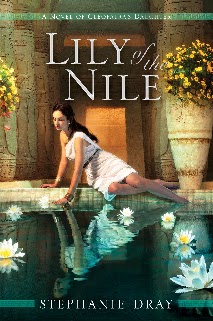
Book Giveaway: Lily of the Nile by Stephanie Dray

“You are Cleopatra’s daughter,” he finally said. “But will you be mine, Selene. That’s the question, isn’t it?”

I could see it then, for the first time, as I had never seen it: he needed a protégé. He wanted me to belong to him, in spite of himself. My mother had also played this game with dangerous Romans. I must learn to play too. – Selene, Lily of the Nile


The saying "History is written by the victors" seems especially appropriate when applied to the late Ptolemaic period of Egypt, in which Cleopatra VII lost her ancient kingdom to the Romans under Octavian Caesar. History records a great deal about one of the most famous of Egyptian queens, including her liaison with Julius Caesar, and the son she bore him, as well as her love for Marc Antony. Less detail is available about the children Cleopatra gave Marc Antony. Now, author Stephanie Dray has researched the past and delved into the mysterious lives of the young children left behind when Antony and Cleopatra committed suicide.

The twins, Alexander Helios and Cleopatra Selene are born to privilege in the great city of Alexandria, where their mother is queen of Egypt and their father a celebrated Roman triumvir. At their births, the Egyptians hail them as saviors. It is not long before their mother calls upon the twins to do just that. Both bear a heavy burden in a struggle to preserve Egypt and their own lives against the rapacious intent of the conqueror Octavian Caesar.

Shackled with Helios and her younger brother Ptolemy, Selene publicly submits to Octavian in Rome, but she cannot forget the past in which she was destined to be a queen and inherit her mother’s mantle of power. Strange markings appear at random on her body, leaving her weak and bloodied, but also defiant. Now a political prisoner, she dwells with Octavia, Caesar’s sister, and the estranged wife of her father Marc Antony. Life in the household of her enemies is uneasy, as Antony’s other children look on Selene as an interloper and a threat to their positions with Octavian. A budding relationship with Juba, the deposed prince of Numidia and a close friendship with Julia, Octavian’s only daughter, offers Selene some comfort. Yet, Octavian’s obsession with the image he has cultivated of her mother continually endangers Selene, as does her brother’s determined struggle against their captors. One choice remains for her: to win or die.

Ms. Dray’s debut is vibrant, well researched and an easy read. I finished it in less than 24 hours. The ancient world comes to life with her excellent characterizations. Selene and Helios are two sides of the same coin, an equal match in varying strengths, but she stands out for her ability to play Octavian’s games and even master them. Octavian truly stands out as the villain of this novel, and Ms. Dray summarizes his personality well. His misogynistic attitudes toward Roman women lie at the heart of his obsession with Cleopatra, and later, her daughter. The fact that Selene is able to contend with his machinations is a true testament to her personal strength.

We hope you enjoyed this review of Lily of the Nile. Please leave a comment to win a FREE signed copy of the book. Tell Stephanie Dray what fascinates you about Cleopatra and ancient Egypt for your chance to win.

Saturday, June 19, 2010

Selene of Alexandria

SELENE OF ALEXANDRIA'Selene of Alexandria' by Faith L. Justice, is a historical novel, a straight one if you are into genres and subgenres, which is set in Alexandria during the fifth century.
Selene is only fourteen, when she makes a serious decision concerning her life. She wishes to defy her class's expectations by becoming a physician. At those times, this is an absolute No-no. She finds support in Hypatia, the famous female mathematician and philosopher. She convinces her father to allow her pursuing her goal in a time, in which the Catholic Church is torn in sects, and Byzantine is all that remained from the Roman Empire. Soon, Selene finds herself amidst the struggle for power.
Embedded in the history of Alexandria, we watch Selene come to age. We experience the violence and fanaticism, tearing through the young church and the few remaining pagans. Selene is the strong and very independent woman type, maybe a tiny bit too modern in her ways; however, Faith manages to let us forget that Selene’s story is her vehicle to introduce us to Hypatia’s life.
The characters are well-drawn, the plot propels us forward, and the writing carries us easily throughout the story. Even the antagonist comes across as a fully fleshed out person. Especially the depiction of all the historical figures we see through Selene’s eyes and the level of authenticity are remarkable. No doubt, Faith has done her homework very well.
Having enjoyed reading it and being left curious about a sequel, I would like to recommend 'Selene of Alexandria' to the lover of straight historical fiction who cherishes authenticity and wants to learn about the dusk of the classical era and the dawn of Christianity.

Wednesday, September 30, 2009

The Heretic Queen by Michelle Moran


Summary:

In ancient Egypt, a forgotten princess must overcome her family’s past and remake history.

The winds of change are blowing through Thebes. A devastating palace fire has killed the Eighteenth Dynasty’s royal family—all with the exception of Nefertari, the niece of the reviled former queen, Nefertiti. The girl’s deceased family has been branded as heretical, and no one in Egypt will speak their names. A relic of a previous reign, Nefertari is pushed aside, an unimportant princess left to run wild in the palace. But this changes when she is taken under the wing of the Pharaoh’s aunt, then brought to the Temple of Hathor, where she is educated in a manner befitting a future queen.

Soon Nefertari catches the eye of the Crown Prince, and despite her family’s history, they fall in love and wish to marry. Yet all of Egypt opposes this union between the rising star of a new dynasty and the fading star of an old, heretical one. While political adversity sets the country on edge, Nefertari becomes the wife of Ramesses the Great. Destined to be the most powerful Pharaoh in Egypt, he is also the man who must confront the most famous exodus in history.

Sweeping in scope and meticulous in detail, The Heretic Queen is a novel of passion and power, heartbreak and redemption. – Crown


Opening Line: I am sure that if I sat in a quiet place, away from the palace and the bustle of the court, I could remember scenes from my childhood much earlier than six years old.

The Heretic Queen is a sequel to Nefertiti, however, you don’t have to read the first book to enjoy this one. Both stories can easily stand alone.

For those who love Ancient Egypt, with all its mysteries and brutalities, this novel will surely please. The gentle, unassuming prose lulls readers deep into the story, capturing interest and garnering suspense with each page turned. It is the story of a young, orphaned princess, shunned because of the sins of her ancestors, who faces adversity and achieves the highest rewards. Filled with palace intrigues, murder plots, greed, love, and desire, The Heretic Queen is sure to please. A highly recommended read!